Building a Reusable Topic-Ideation Skill from a Top Creator's Experience
Lately all kinds of "distilled celebrity" skills have been popping up. Some of it is clearly parody, but it does reflect real demand.
Having done independent media for this long, I've found that with so little back-and-forth feedback available, learning from the experience of industry experts and people who publish consistently is still very much necessary for improving myself.
So today let's put it into practice: how to "distill" an excellent creator's experience into a reusable "topic-ideation Skill."
The whole process has four steps: collect, convert, analyze, package.
1. Gather the raw material (1–2 hours)
Before you start, the first job is to choose the account and collect high-quality raw material.
When screening, sort by date. If you can see an account where likes and views swing noticeably—from tens or hundreds up to tens of thousands or hundreds of thousands—it's usually more worth studying; if an account has been flat for a long time, there's no need to use it as a model.
Ideally, the raw material comes as copyable text or transcripts. But in reality, what you run into more often is content you can't copy directly: non-text data such as audio and video, and social media content you can't scrape.
That's when a bit of manual work is needed:
- Download audio and video with a tool first, then transcribe with an ASR tool.
- For social media content you can't scrape, take screenshots first, then convert them with image recognition (OCR).
You can't skip this step, but you do need to cap the time: the goal is to finish digitizing and collecting the material within an hour.
If this step is eating a lot of time, assess whether there's a better method—or whether it's really worth continuing.
2. Processing the content: smart recognition and proofreading (0.5–1 hour)
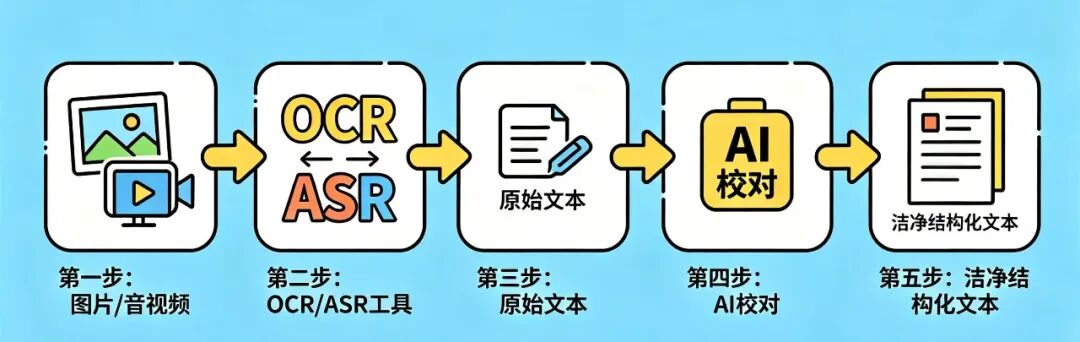
Our topic-ideation Skill material is mainly screenshots in image form, so here's how to extract the text with an OCR tool.
## 1. Choosing an OCR option
There are plenty of OCR options, for example: the Preview feature built into macOS, or the image recognition tools offered by Baidu, Qwen, DeepSeek, and others.
I recommend Baidu's Paddle OCR. It has been deep in Chinese OCR for a long time, and the coding training data for quite a few large models includes related sample code, so it's easy to get started with.
Why not just use a multimodal model to read images?
It's feasible, but not recommended. When handling batches of material with complex layouts, a dedicated OCR tool usually has the edge in efficiency, accuracy, and controllability. Our goal is high-quality text input, so precision at this step is crucial.
## 2. Debugging and optimization:
I suggest writing the processing script with an AI coding tool to boost efficiency. The flow is as follows:
-
Prepare a folder containing 4–5 samples of different types (plain text, mixed text and images, complex layouts).
-
Use a prompt like the one below to generate the script (replacing the content in the brackets):
写一个 python 脚本,使用【百度 Paddle OCR】对【自媒体截图】文件夹下的截图内容进行提取,最后输出【csv格式的表格】,内容为:

【标题、摘要、时间、点赞数、阅读数,类别…】
- Run the script and check the first-pass recognition results.
## 3. Feedback and adjustment
Recognition is rarely 100% accurate, so at this point you enter a debug loop:
Check the recognition results and tell the tool exactly which parts it got wrong (dates, special symbols, scrambled layout).
Iterate until the recognition rate on the main samples reaches a satisfactory level, then process the remaining material at scale.
Tip: OCR tools return coordinate information for the text, which lets you describe problems precisely. For example, when recognizing content type: an image on the left with text on the right means an article; an image on top with text below means a video.
## 4. Text proofreading
After recognition and conversion you'll have a batch of first-draft text. But whether it comes from ASR, OCR, or a direct copy-paste off a web page, it inevitably carries all kinds of "noise"—typos, garbled characters, redundant spaces, inconsistent formatting, even paragraphs wrongly merged or split.
So before entering the core "analysis" stage, you have to do a thorough proofread and clean-up of the information. The goal of this step is to turn rough "raw text" into clean, structured "analysis-only text."
Doing it purely by hand is slow and laborious. At this point a large model can switch from "recognition tool" to "proofreading assistant."
请校对以下文件的文本,完成以下任务:
纠正所有错别字和错误标点。
统一全文的日期格式为 YYYY-MM-DD。
清理多余的换行和空格,使段落清晰。
如果发现明显的重复语句或与主线无关的广告、评论内容,请直接删除。

【待校对的文件路径】
Even though AI's proofreading ability is strong, for terminology or context-specific phrasing I still suggest a quick skim to double-check—especially the content AI deleted, to confirm it really is irrelevant.
Also, keep a copy of the pre-proofread original text as a backup.
3. Analysis and evaluation (10 minutes)
Once you have clean text material, don't rush to extract concrete operating steps. First have the large model analyze at both the macro and micro level, so you understand the logic behind the success.
Core prompt example (replacing the content in the brackets):
请分析这个自媒体账号的成长历程:

他/她是如何成长起来的?关键节点是什么?
为什么【其早期每篇文章都能获得过千阅读】?
为什么【后期即使发布纯文字内容,依然能保持高关注度】?
## Advanced move: multi-model comparative analysis
If you can access several large-model APIs (such as GLM, MiniMax, Kimi, DeepSeek), it's strongly recommended to submit the same material to different models separately for analysis. Compare their analysis reports, then pick the one with the most unique perspective and the deepest insight as the blueprint for the subsequent "distillation."
This step ensures your skill is built on high-quality analysis.
If a single pass of analysis isn't deep enough, keep asking "why" and drill down through multiple rounds of conversation.
If the analysis quality is consistently unsatisfactory, you most likely need to go back to step one and add material with more dimensions or higher quality. You can also add more analysis subjects (analyze several comparable high-quality accounts) and then do a cross-comparison.
4. Generating a reusable skill package
The last step is to "compile" the high-quality analysis report into a concrete, executable, reusable skill.
Many AI platforms support defining a skill in natural language (Create Skill). You can submit the best analysis description from the previous step directly and generate a first-draft skill script or instruction set.
If you're not familiar with the specific platform, you can use Anthropic's Skill-creator as a guide.
Open-source address: https://skills.sh/anthropics/skills/skill-creator
Example prompt for generating the Skill:
使用 【skill-creator】,根据你刚才对【XX账号】的分析,为我创建一个适用于【科技领域自媒体】的"选题灵感生成"Skill。
Usually, the AI will tell you it has generated a SKILL.md document under the skill folder of the current tool. You can preview it, or ignore it. What matters more is testing:
Trigger test: try running or triggering this Skill and confirm that it works.
Results check: provide a few specific scenarios or keywords and check whether the topic suggestions the Skill generates meet expectations.
Iterative optimization: based on the test results, give feedback to the AI and make adjustments (e.g. "the topics it generates are too broad—please focus more on the narrower niche of AIGC tool reviews").
The final result
Through the four steps above—collect, convert, analyze, package—you can systematically turn someone else's scattered, tacit experience into a workable intelligent skill that belongs to you.
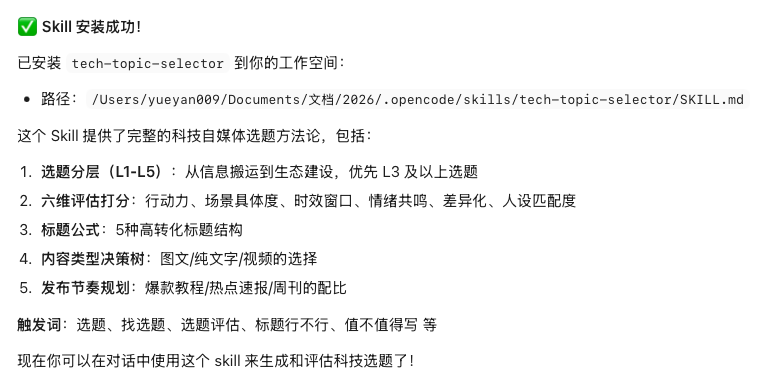
This is the skill I generated. Here's how the large model described it after installation:
And here's how it scored my earlier topic ideas:
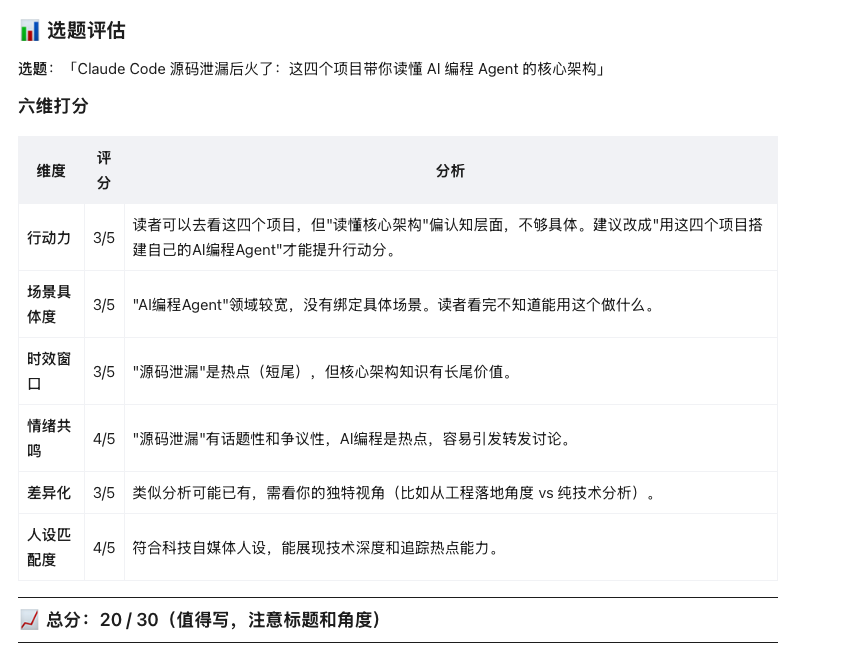
You can see the opinions and suggestions are more to the point and more effective than what you get from talking to a large model directly.
That's all for today's share. If there's a skill you especially want to "distill," leave a comment. If I find it interesting, I might put out a dedicated tutorial.
Previous posts:
Weekly Notes 07 | AI vetoed my topic, and I despaired at Agents writing code
Weekly Notes 06 | Being "distilled" just proves you've got something worth stealing
Anyone can create: the core structure and endless possibilities of AI Skills