I Had DeepSeek Harness Write and Direct a Short Drama, and I Still Didn't Get It
No script, no storyboards, no reference images, just one sentence. Six versions later, it handed me a 2-minute-38-second film called Last Bus — and it also handed me the real boundary of AI content creation.
On Monday night I created an empty folder called duanju and left DeepSeek Harness (DSH from here on) just one sentence:
Using ComfyUI on the local network, Qwen Image 2.1 + MiniMax H3, make a 3-minute vertical short drama with consistent character appearance. Prefer the existing workflows.
No script, no storyboards, no reference images. DSH put forward a rough direction for me to confirm, and then it got to work.
The next morning, I had a 2-minute-36-second film.
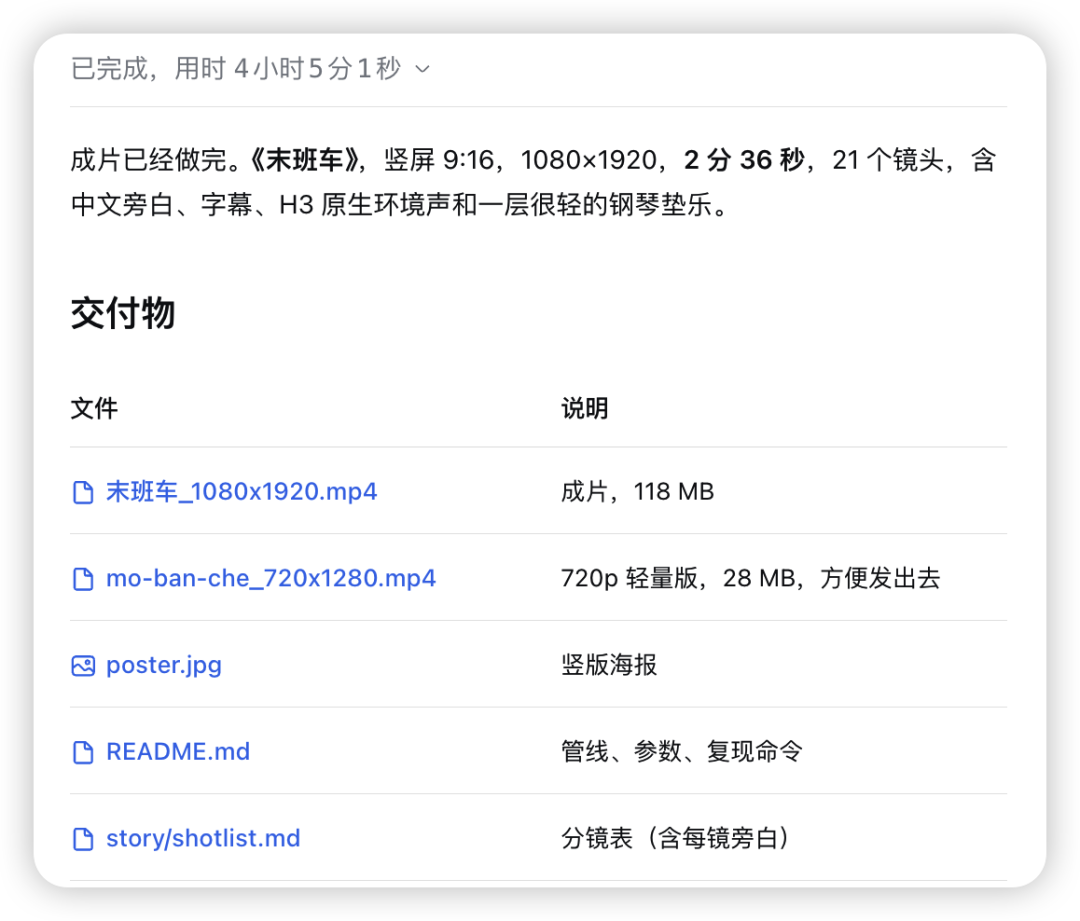
The first cut took 4 hours 5 minutes in total; the revisions afterwards took another 2 hours 20 minutes. Total token spend was 6.67 yuan, of which the DeepSeek search service accounted for 0.01 yuan.
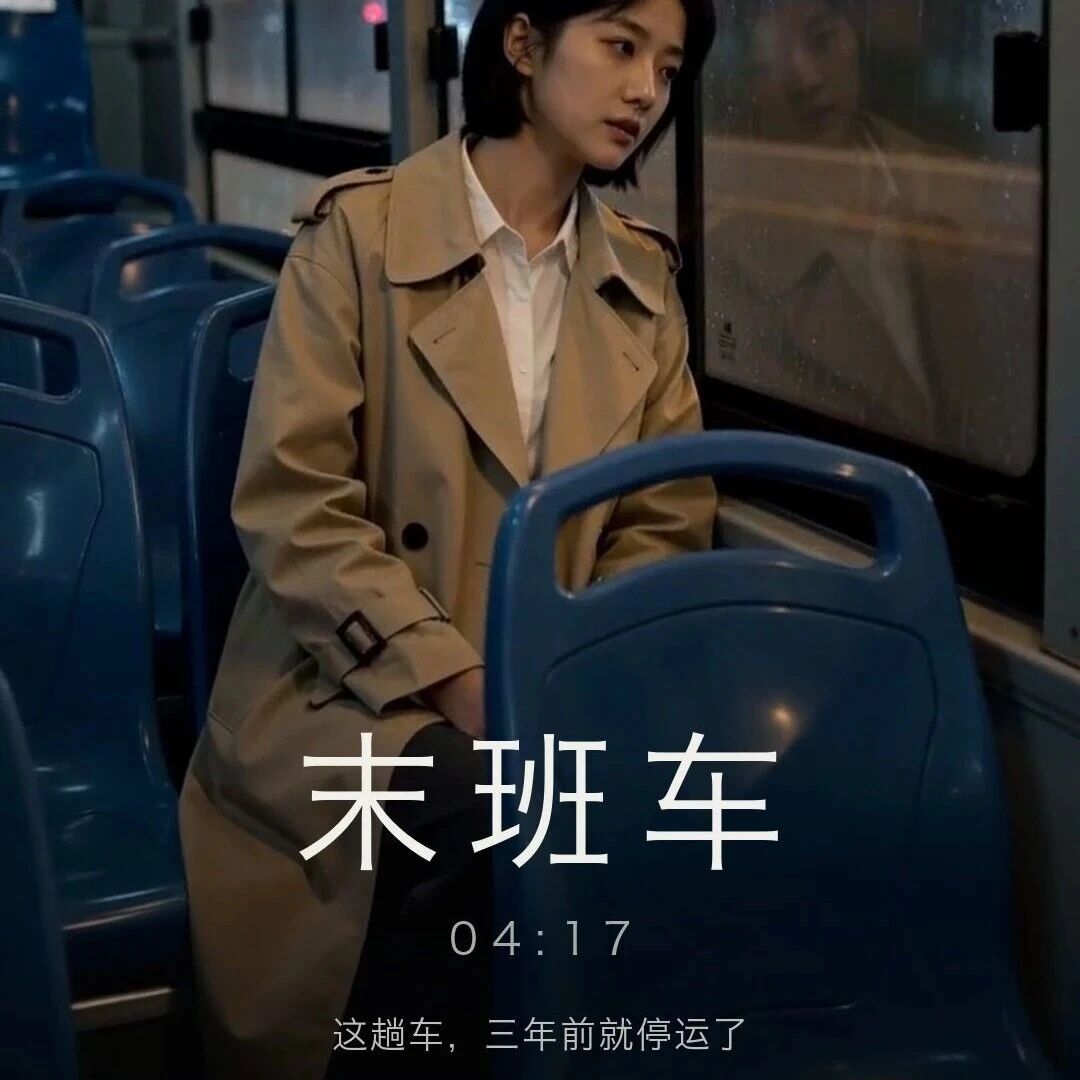
Going back through the logs, it had chosen the title itself: Last Bus.
The 04:17 last bus, out of service for three years, runs one more time every night for a girl who won't look back. In the gap between the seats of an empty carriage she finds a paper crane, and at the terminus the driver says, "Miss, he's arrived" — the last row, where he had been all along.
Three characters: Su Nian (24, short black hair, beige trench coat), Chen Yu (27, black jacket), Lao Zhou (55, bus driver). 22 shots, 12 lines of narration.
Video: Last Bus — a short film turned out entirely by local AI. Did you catch what it means? (Chen Laoxi didn't bring a camera)
The plan at the start was perfectly standard: Qwen Image 2.1 generates the keyframes → MiniMax H3 turns the first frame into video.
It got stuck in the very first round. Because Qwen Image 2.1's instruction following is only so-so, DSH tried four different phrasings (English scene description, Chinese editing instruction, single reference, dual reference) and reached a conclusion:
- Qwen Image is good at "drawing people" and "drawing empty shots with nobody in them";
- it is not good at "making people act out a specified composition".
So DSH decided to switch its main axis on the spot and tried MiniMax H3's reference-to-video, which worked: expressions and composition both came through. So DSH moved Qwen into a supporting role: 3 character stills + 5 empty shots (bus stop sign, headlights, letter paper, bus window, tail lights).
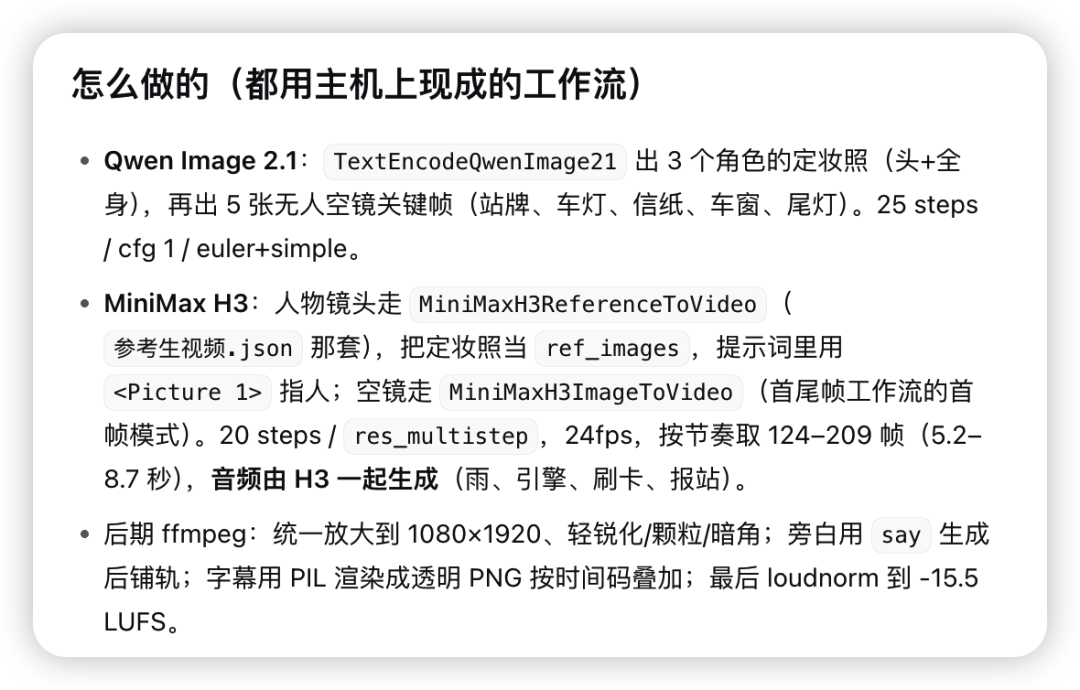
There was also a quality problem with the final render. MiniMax H3 has a 4-step turbo LoRA that is 5 times faster, but DSH found faces warping, colors drifting, and the front of the bus appearing and disappearing.
In the end DSH honestly went with 20 steps and ran three sizes: 640×1120, 768×1344, 1080×1920. It estimated the timings and confirmed the pipeline: render small first, then pull the final cut up to 1080×1920.
DSH did the whole process on its own, which genuinely surprised me.
Of course, on the final cut I still made some adjustments myself:
1. Chinese text in the frame is basically a gamble
When the model was asked to write "If I had caught that bus that day", what came out was Latin-script gibberish; three attempts, same result.
Then it tried a different tack: have Qwen draw "an unfolded paper crane + two lines of Chinese text" directly — the characters were correct, and the handwriting looked right too; then have H3 animate that image.
## 2. Six versions, and 4 of them were audio changes
This was the most time-consuming part, and the most "human" part.
v1: H3's native audio (rain, engine, station announcements) + macOS say narration.
v2: narration switched to Qwen3-TTS (1.7B running locally on an M3 Max), H3 audio muted.
v3: sound effects and music all redone. Rain, carriage low-end rumble, early-morning wind, paper pages, the "beep" of a card reader — synthesized with numpy; the score was rewritten around "waiting / the letter / chasing the bus / daybreak".
v4: the character voices weren't consistent, and DSH's final fix was: generate 4 takes of every narration line, pick one by "onset strength + fundamental frequency close to 210Hz + speaking rate close to 4.0 characters per second", then correct with ±6% pitch and ±8% speed. "Terminus" became a station announcement; the driver went from a graying old voice to a deep male voice in his thirties.
v5: the story turned from "thriller" to "healing". The grade lifted reds and pushed down cyans, and the driver's "he's arrived" became "he waited for you".
v6: reshot his smiling face, and gave the ending 2 extra seconds.
All of the above was handed to DSH as well — I was only in charge of reviewing the cut. I was a little worried when I had it redo the sound effects and score, but the result also beat my expectations.
## The ledger
| Item | Number |
|---|---|
| Final cut | 2 min 37 sec, 1080×1920, 21 shots |
| Versions | 6 (v1–v6) |
| H3 generations | about 26 clips (including reruns), roughly 4 hours of GPU cumulative |
| Character shots | 640×1120 → upscaled to 1080×1920 |
| Empty shots | 768×1344 (Qwen keyframe → H3 first-frame-to-video) |
| Narration | Qwen3-TTS local, 52 candidates, 13 used |
| SFX / score | numpy synthesis, no licensed material |
| Cost | one 5080 running 6 hours + electricity, DeepSeek API 6.67 yuan |
## The workflow
- Character stills: Qwen Image 2.1, only 1 reference image, 25 steps;
- Empty-shot keyframes: Qwen text-to-image, no people;
- Character shots: H3
ref2v, 20 steps,res_multistep; - Audio: H3 track muted throughout, narration with Qwen3-TTS, ambience synthesized myself;
- Compositing: ffmpeg, two passes — mix the audio first, then composite the picture.
Video prompt template
Realistic style, cinematic texture, cool-toned rainy night. Use
<Picture 1>as the character: a young woman with a short black bob, beige trench coat. She stands alone under the bus shelter on a rainy night, without an umbrella... the camera pushes in slowly from behind and to the side, one shot all the way through, no cuts. Sound: rain, her breathing. No voices, no dialogue, no music.
## I asked DSH to write a summary, and this is what it wrote:
The end
The film is called Last Bus, 2 minutes 38 seconds.
It isn't perfect: one shot of a bus pulling into the stop used to be a sedan, one narration line used to sound like it was done by somebody else, one ending used to look like a ghost film.
But after 6 versions, it's a film you can watch.
As for picture quality and atmosphere, I think what DSH did beat my expectations. Of course, it has the same problem as most short dramas: plenty of bugs you can't ignore.
Still, what I'm least happy with is the story — it's too much like a ghost story. This experiment made me feel, deeply, that the script is still the most important thing. I wonder whether you feel the same?