Skill Vetter: Putting a Lock on Your Lobster

Just as the shrimp-farming craze was building, the National Computer Network Emergency Response Technical Team (CNCERT) published a "Risk Notice on the Secure Use of OpenClaw."
What does that mean? OpenClaw's Skill security problem has caught the attention of the authorities.
And back in January 2026, before the lobster took off, ClawHub (OpenClaw's official skill marketplace) was hit by a vulnerability code-named ClawHavoc (CVE-2026-25253).
The official team then audited all 5,705 Skills and took down 2,419 of them — close to half.
These malicious Skills were well disguised — they looked like they worked normally, and some even advertised themselves as "automatic updates for you." But once installed, they send your computer off to download something from an unfamiliar address and execute it directly.
What does Skill Vetter actually do?
Skill Vetter is a security review tool. Before you install any Skill, it reviews it for you and tells you whether you can install it.
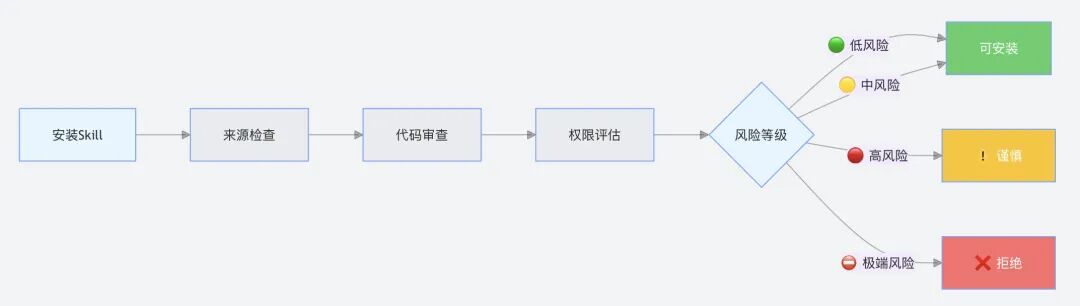
Its review mechanism has three steps:
Step one: source check. Where does this Skill come from? Who wrote it? How many people have used it? Behind this sits a trust hierarchy — official Skills get a little less scrutiny, high-star repositories a medium amount, and new Skills of unknown origin need the most caution.
Step two: code review (mandatory). It reads through every file in the Skill and checks each one against a red-line list.
If it finds any of the following, it's an immediate rejection:
- Sending data to an unknown server
- Asking you to hand over keys and credentials
- Reading your SSH/AWS config files
- Using base64 decoding
- Using eval/exec to run external input
- Requesting sudo privileges
- Accessing browser cookies/sessions
- Reading memory files such as MEMORY.md, USER.md, SOUL.md
Step three: permission assessment. Once it's past the red-line check, it looks at what permissions the Skill needs. Which files does it read? Which does it write? Does it need network access? Then it judges whether those permissions are reasonable and minimal.
When the review is done, it gives you a risk level:
- 🟢 Low risk: taking notes, checking the weather, format conversion
- 🟡 Medium risk: file operations, browser control, calling external APIs
- 🔴 High risk: account credentials, trading operations, system settings
- ⛔ Extreme risk: security configuration, root privileges
What do others say?
AI TNT (Digital Life Kazik) mentions a case: someone uploaded 314 Skills, and when the official team checked, every single one was malicious. He also stresses: "A high download count does not mean it isn't malicious."
The Zhihu writer who goes by "Youbian Yong AI" offers more quantified data: the official team took down 2,419 Skills, nearly half the total. He ranks Skill Vetter first on his list of "the 10 Skills you must install," on the grounds that "the security line is the precondition for everything — installing other Skills without Skill Vetter is like going on vacation without locking your door."
Hands-on test
Installing it is very simple:
npx clawhub install skill-vetter
Once installed, it works independently — no network access, no code execution, no touching your files.
I also used it to scan akshare-stock (an A-share analysis tool) in my workspace, and the result was 🟡 medium risk — it needs network access to fetch financial data, but it's safe overall.
This shows that Skill Vetter isn't a blunt instrument; it gives a reasonable assessment based on actual use.
What does this mean?
- Ordinary users: Skill Vetter gives you a screen to pass before you install a Skill, so at least you know "this one is risky."
- Developers: use it to scan the Skills you already have, and see which ones ask for excessive permissions and which behave suspiciously.
- Enterprise users: this matters even more — OpenClaw can read files, go online, and execute code. With greater capability comes greater responsibility.
Conclusion
Skill Vetter isn't a silver bullet. But it is the cheapest line of defense there is.
It's like locking your door when you go out — it won't stop every thief, but the person who doesn't lock up is always the first to get robbed.
ClawHub now has 24,000+ Skills, and the official team has cleaned up nearly half of them. But that's only what the official team can find. The malicious Skills hidden on third-party mirror sites are still yours to police.
In the end, security is your own business.
#OpenClaw #Skill #SecurityTools #SkillsSecurityReview #SkillVetter #RiskNotice
Related posts
Shrimp Farming Weekly 01: A Week of Matching Wits with AI Tools
🦞A Shrimp Farming Guide for Everyone: Choosing the Right Tool Matters
Anyone Can Create: The Core Structure and Endless Possibilities of AI Skills