AI Concepts Explained: Agents, Skills, and MCP
What do these terms that keep showing up in AI apps actually mean? Here's how to understand them from the perspective of running a company.
You're the boss of a company, and your only employee is an incredibly capable AI assistant named "All-in-One Little Assistant."
At first everything goes smoothly: looking things up, writing reports, sending emails—he's great at all of it, and you're delighted.
But as the business grows, you realize one person simply can't keep up—data analysis, scheduling, poster design... everything is urgent, and you start to miss the old days when you were poor but relaxed.
Then an old friend suggests: "Hire a few employees and let the All-in-One Assistant be their leader, handling coordination while the actual work goes to the team."
That's how the division of labor between "Agent" and "SubAgent" works in the AI world.
Agent: The Capable Robot Employee
In the AI field, an Agent is like an all-around assistant that can understand needs and execute tasks autonomously.
It's like a robot with a brain: not only does it understand instructions, it also plans out how to complete them on its own.
Unlike traditional software, Agents can think, grasp intent, and adjust strategies flexibly. In an AI system, the Agent is responsible for understanding user input, analyzing needs, planning steps, coordinating resources, and delivering results—it is the system's "brain."
SubAgent: The Team Members Who Each Handle Their Own Part
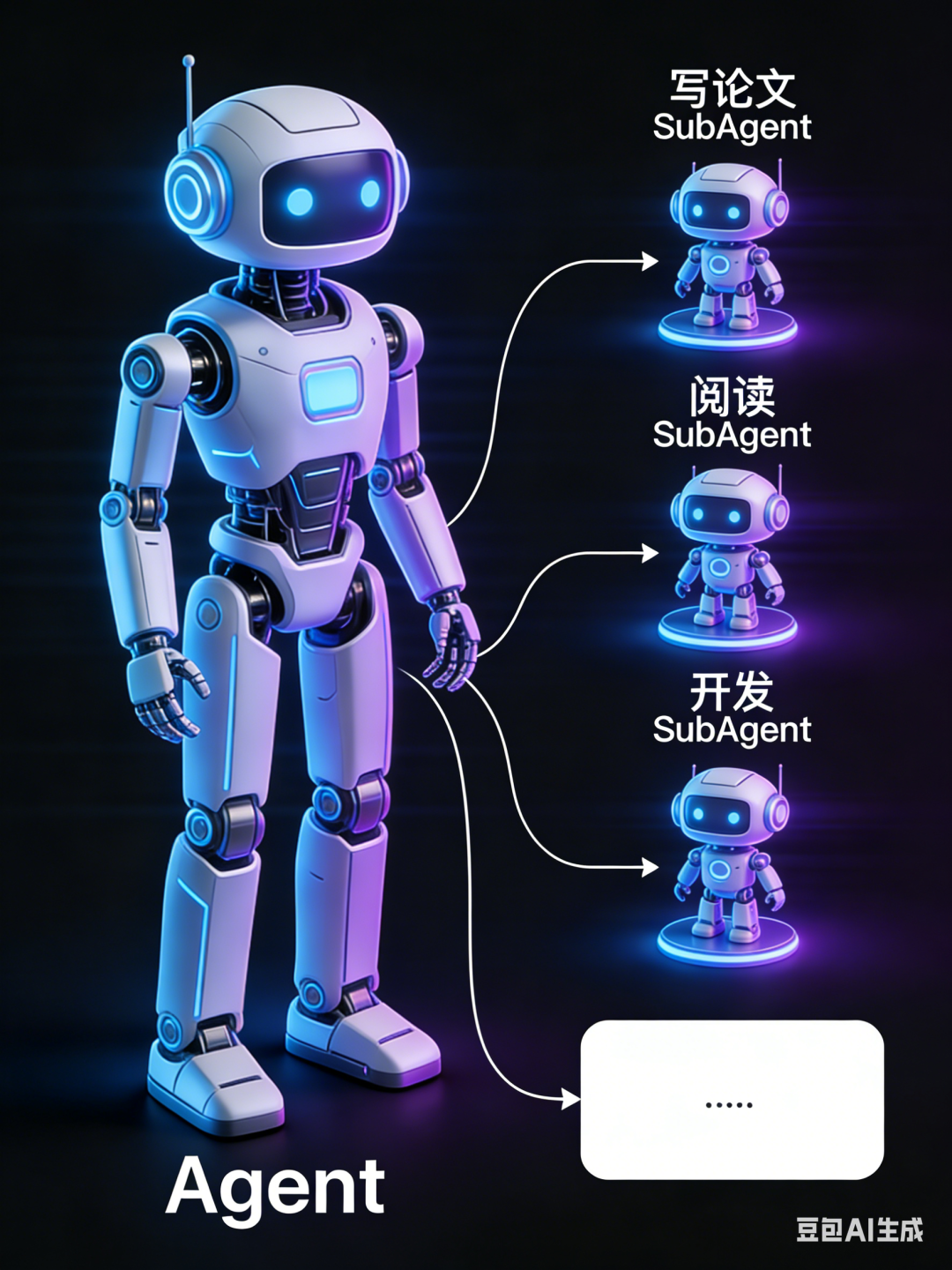
When you give the All-in-One Assistant some subordinates, you've introduced SubAgents.
For example, "Xiao Wang the researcher" handles information lookup, and "Xiao Li the wordsmith" handles copywriting. A SubAgent is subordinate to the Agent and handles concrete work in a specific domain, while the Agent acts as the leader in charge of overall coordination.
The benefits of this division of labor: first, specialization—each SubAgent hones its skills to the limit in the area it excels at. Second, flexibility—when new tasks come up, you can add or remove team members at any time. Finally, efficiency—the Agent can launch multiple tasks in parallel.
In practice, a complex AI system may have multiple layers, giving it both unified command and flexible maneuverability.
Skills: Superpowers Anyone Can Have
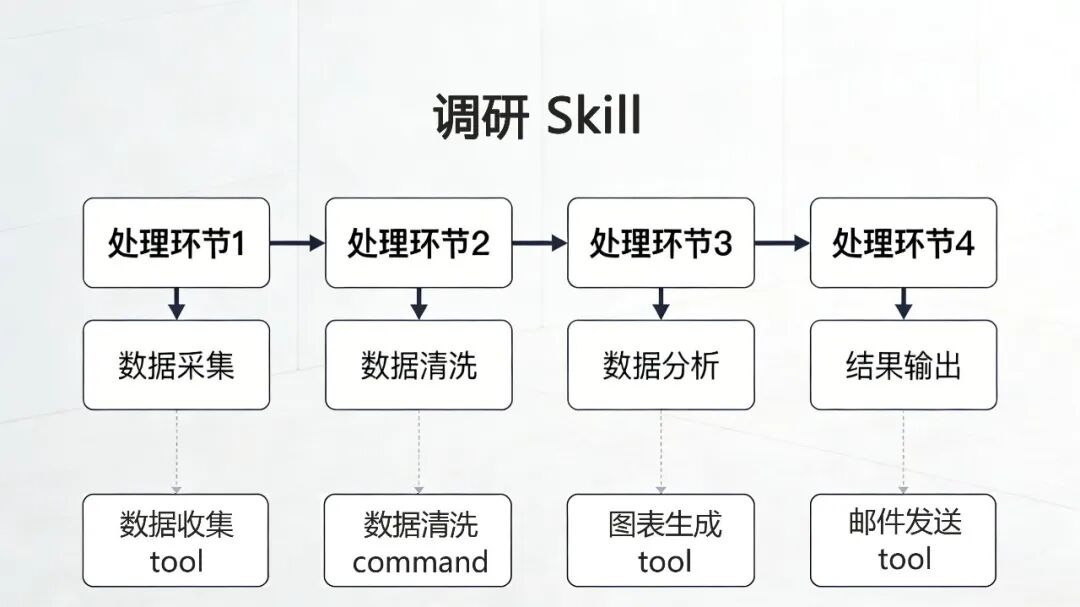
As the team stabilizes, you notice that some workflows are fixed and repetitive. In AI, this kind of packaged, reusable, invocable capability is a Skill. It encapsulates complex operations and exposes only a simple interface—like a "skill capsule."
Skills are characterized by "standardization" and "shareability." Once a process is packaged as a Skill, anyone can use it directly without learning it from scratch. Common Skills include sending email and searching for information. They can be accumulated and combined, making the system stronger and stronger, and they can be passed down, ensuring that work isn't affected by changes in personnel.
How Skill differs from Tool and Command:
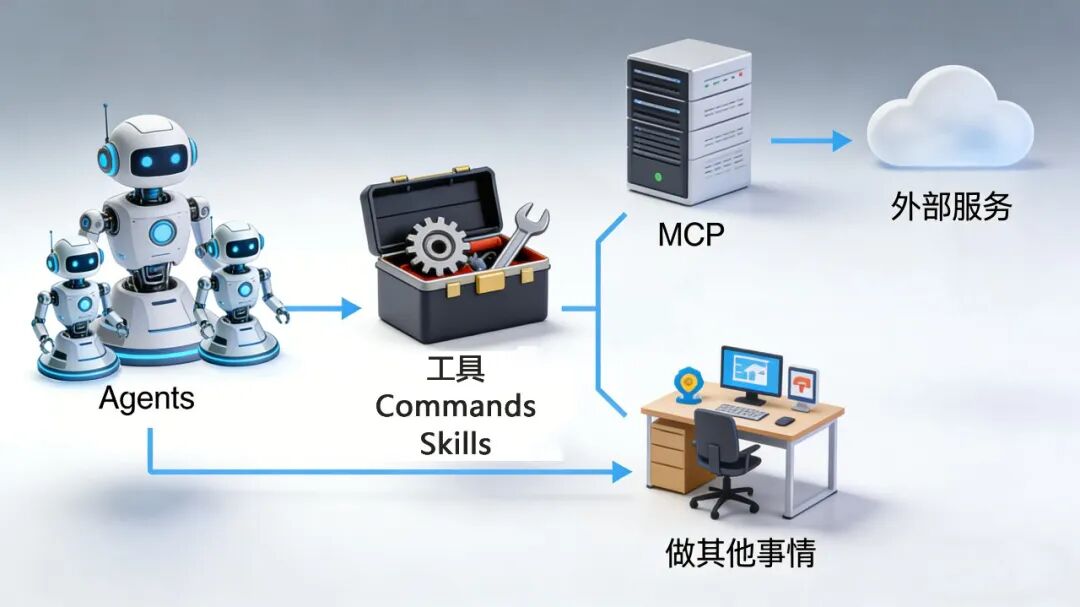
- Tool: In AI, this usually refers to a packaged module or interface with a specific function, such as a "web search tool" or a "code execution tool." It provides a capability, but the caller decides how to use it.
- Commands: These are instructions that trigger the AI to perform a specific operation, usually more direct and atomic. For example, typing
/clearto clear the history. - Skill: This is the highest level of abstraction, representing a complete business process or task solution with a clear goal. Inside a Skill, steps are planned intelligently, and multiple Tools or Commands are coordinated and invoked to achieve the goal. For example, the Skill "generate a weekly market analysis report" might automatically decide to first call a "data collection Tool," then use a "chart generation Tool," and finally send the report out through an "email sending Tool."
There's no clear line between Skill and Command; the difference is more a matter of architecture. Skills are more complex and use Commands inside to complete subtasks. But users can also activate a Skill through a Command.
MCP: The "Protocol" for Talking to the Outside World
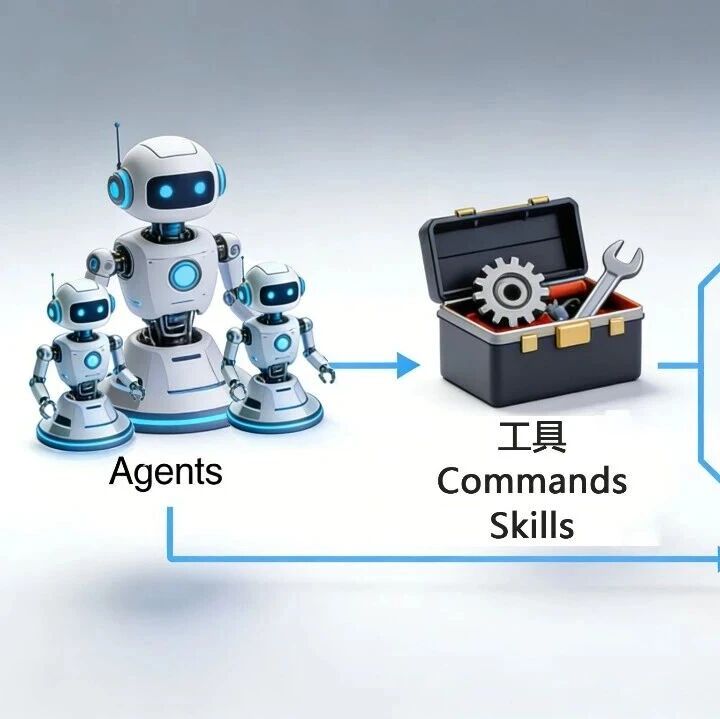
When you need to connect with external platforms, MCP (Model Context Protocol) comes into play. It's a standardized interface specification—like a "standard contract" signed between a service provider and an AI system, defining the format and rules of communication so that different systems can work together smoothly.
MCP is developed and maintained by the service provider; the AI system only needs to integrate it to call the capabilities.
Its benefits include: standardization—one unified spec, with no need to build a separate integration for each service; plug and play—quickly integrate new services; a thriving ecosystem—lowering the barrier to integration.
MCP lets different services be called by any AI system that follows the protocol, greatly reducing integration costs.
A few more examples:
- For Baidu Netdisk, there's baidu-disk-mcp;
- For Amap, there's amap-mcp;
- For Feishu, there's feishu-mcp.
Every kind of service can have its own MCP tool, just as every appliance has its own plug—but as long as it follows the "power protocol," it can plug into the grid.
Putting It All Together
Now let's connect all the concepts and see how a complete AI system works.
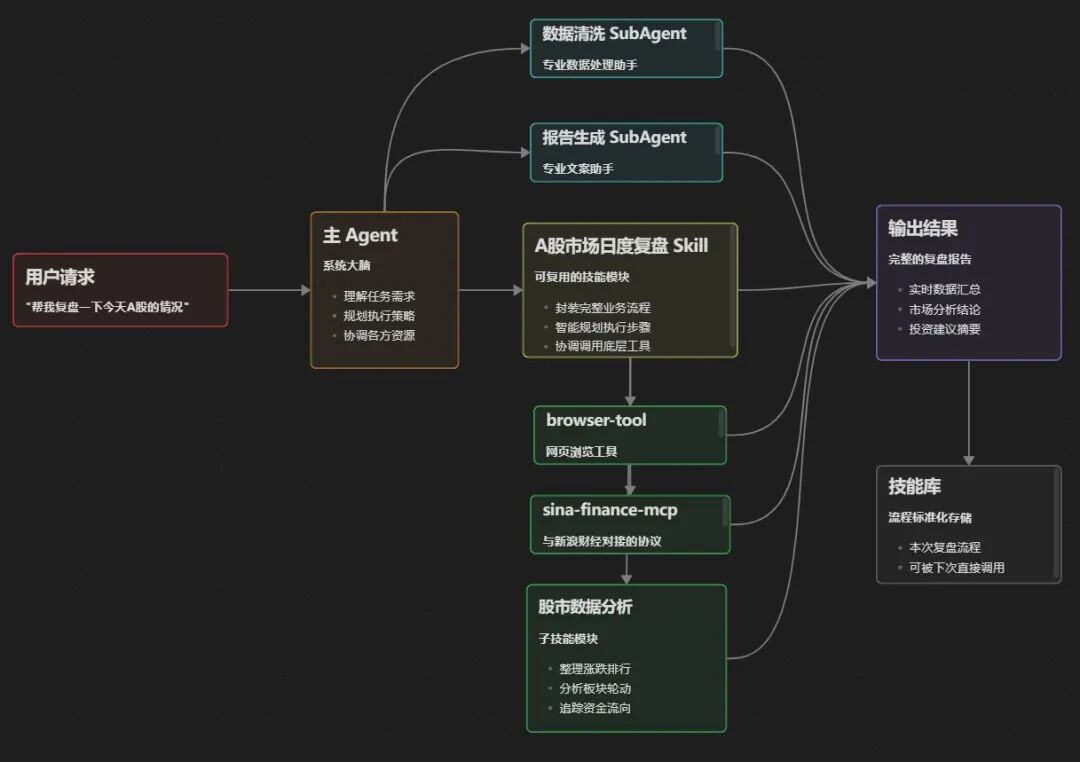
Suppose a client says, "Help me review today's A-share market." The main Agent receives the task and analyzes it: this requires real-time stock market data, browsing financial news, and some preliminary data analysis. The Agent checks its skill library and finds a ready-made Skill, "Daily A-share Market Review," that it can use directly.
Behind this Skill are the MCP protocol and various tools. For example, it uses sina-finance-mcp to get real-time quotes from Sina Finance, and browser-tool to automatically grab key financial news and announcements. Inside the Skill, steps are planned intelligently: first call MCP to get data, then use the browsing tool to collect market sentiment information, and finally call the "stock market data analysis" sub-skill to organize the gainers and losers rankings, sector rotation, and capital flows.
The whole process flows smoothly, and the Agent doesn't need to know the API details of each data source or the complex logic of web scraping. If the task is more complex, the Agent can also call in specialized SubAgents—for example, having a "data cleaning SubAgent" preprocess the raw data and a "report generation SubAgent" write the analysis summary, before the Skill integrates everything into a complete review report.
When it's done, you can package this process as a standard Skill and add it to the skill library. Next time you need a market overview, just invoke it—no need to start from scratch.
Summary: The Art of Division and Collaboration in the AI World
Let's take a macro look back at these concepts:
- Agent is the core brain, responsible for understanding tasks, planning strategy, and coordinating resources—like a project manager directing operations.
- SubAgent is the subordinate team, executing tasks in specific domains—like a soccer team where everyone plays their role and works together.
- Skill is a reusable capability module that encapsulates fixed processes—like a tool in a toolbox, ready whenever you need it.
- MCP is the protocol standard for connecting to external services, the bridge between AI and the outside world, letting systems speak "the same language."
These four concepts complement one another and form the basic architecture of a modern AI system. Understanding them is essential to understanding how AI works and to building powerful applications.
Back at that company, you now have a complete AI team: an Agent that coordinates, SubAgents that divide the work, a library of Skills you can invoke, and MCP for connecting to the outside world. Expanding the business is no longer hard—form a team for new tasks, integrate an MCP for new services, and package common processes as Skills.
This is the AI world: simple yet complex, orderly yet flexible. Agent, SubAgent, Skill, and MCP are the four cornerstones it's built on.