Five Open-Source Short-Drama Platforms, Only Two Worth Recommending
Short-drama production has taken off recently. Beyond sites like Xiaoyunque and libTV, are there any open-source short-drama platforms you can actually use?

Yes, and more than one.
I went through all five projects one by one. I didn't install and run every single one end to end, but I looked at everything that mattered.
Here's the conclusion up front: of the five, only Toonflow is genuinely usable for commercial short dramas. BeefTV counts as half—you can sell the films, but you can't sell the software.
The other three either have licenses that stop you cold or haven't had a code commit in seven months.
1. A health check on all five projects
| Project | Stars | Forks | License | Latest version | Last commit |
|---|---|---|---|---|---|
| Toonflow | 22,429 | 4,070 | MIT | v2.0.11 (11-18) | 2026-11-20 |
| huobao-drama | 17,785 | 3,323 | CC BY-NC-SA 4.0 | v4.0.11 (11-05) | 2026-11-21 |
| Jellyfish | 7,284 | 1,257 | Apache-2.0 | v0.3.2 (04-17) | 2026-04-20 |
| printfilm | 7,207 | 835 | MIT | v0.3.0 (10-15) | 2026-11-20 |
| BeefTV | 2,583 | 491 | Source-available | v2.4.0 (11-21) | 2026-11-21 |
Data as of 2026-11-21
One detail is worth mentioning first: all five repositories were created between January and September 2026.
The oldest is ten months old; the newest is two months old.
In other words, no project in this space has even three years of history yet. The "maturity" you see was all built in ten months.
2. Toonflow: the only one I can recommend without reservation
22.4k stars, 4,070 forks, 32 releases, and it was still shipping on November 18.
Its standout feature is the 3D blockout preview: paste in a script, and it automatically builds sets, places cameras, and blocks actor movement. It produces a first "blockout preview" so you can confirm composition and staging before generating shots with a model.
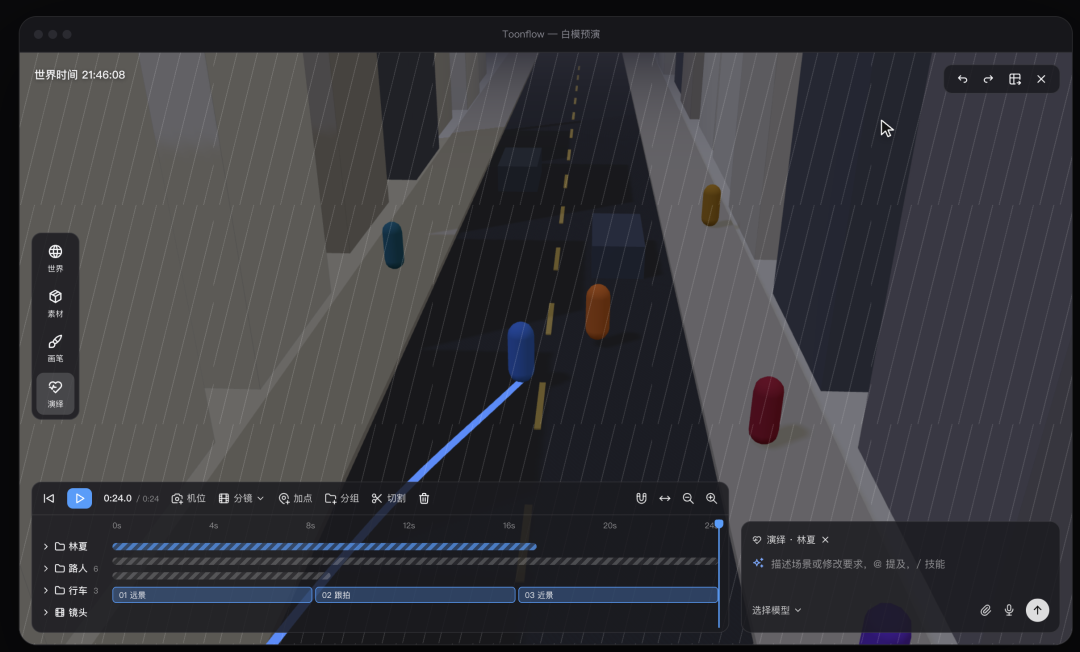
Toonflow blockout preview
None of the other four have this.
The most expensive part of a short drama isn't generation—it's discovering after generation that the blocking is wrong. Blockout preview moves the trial and error to the cheapest step.
The rest of the setup is comprehensive too: an infinite canvas, an AI assistant (with MCP and A2A support), a plugin marketplace, 22 UI languages, Windows/macOS/Linux/Android clients, and Docker deployment.
The license is MIT, so there's no obstacle to commercial use. The README even includes a case study from Hongguo, claiming a work reached over 100 million plays—I can't verify that number, but at least it shows people are actually using it for real work.
If I have to find faults:
- The repo is 313MB and depends on Bun 1.4.3, heavier than a typical frontend project.
- The web version runs on port 3000, and neither the business pages nor the API have authentication. A public deployment needs its own authenticated reverse proxy.
- It iterates so fast that APIs and data structures change; don't hard-code production workflows into it.
In one sentence: if you're serious about commercial short dramas, start here.
3. huobao-drama: easiest to get started, easiest to get burned
17.8k stars, v4.0.11, with desktop dmg/exe installers.
It's the "lightest" of the five: Node 20 + built-in SQLite + built-in FFmpeg. No database to install, no ffmpeg to install—npm install and it runs. The desktop version keeps the database, assets, and Agent skills in the user directory, and uninstalling doesn't delete the data.
The workflow is also the most straightforward, in six steps: create project → configure models → script → assets → storyboard and video → stitch and export.
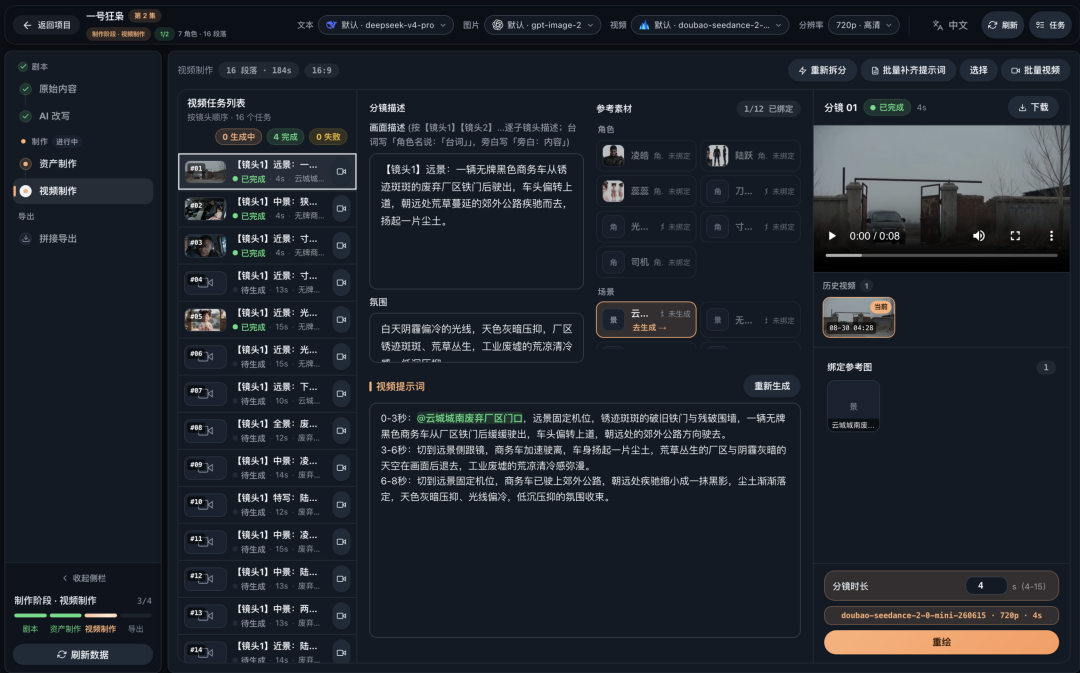
huobao-drama's more traditional video generation UI
Four built-in Agents have clear roles: rewrite the script, extract characters/scenes/props, break down shots, and write prompts. It supports quite a few models too: Seedance 2.0, MiniMax H3, and Wan 3.0 can all be connected.
Then there's the part I really want to focus on.
Its license is CC BY-NC-SA 4.0. NC means NonCommercial. You can play with it at home, use it for learning, or build internal demos—no problem. You cannot use it for client work, run accounts and split revenue, or deploy it for clients.
A lot of people choose tools based only on star counts and screenshots, then discover this clause after installing and getting it running. Switching tools after the film is made costs far more than choosing correctly from the start. If you plan to make money from short dramas, this is a red line.
4. Jellyfish: the best architecture, but it's been abandoned
7.3k stars, Apache-2.0. This is a codebase I've deployed locally and personally like quite a bit.
FastAPI + React, with frontend/backend contracts generating types automatically via OpenAPI; a unified async task center where text, image, and video tasks all share one state machine, with cancel, resume, and jump-back to the corresponding project/episode/shot; characters, scenes, props, and costumes are shared entities, specifically to solve cross-shot consistency.
It doesn't chase "one-click finished video"; it chases "turning AI output into reusable production assets." That positioning is the clearest of the five.
Then the last code commit was April 20, 2026. After that, only README and website updates. The version is stuck at v0.3.2.
No code changes in seven months—for an open-source project, that's basically an announcement that it's abandoned.
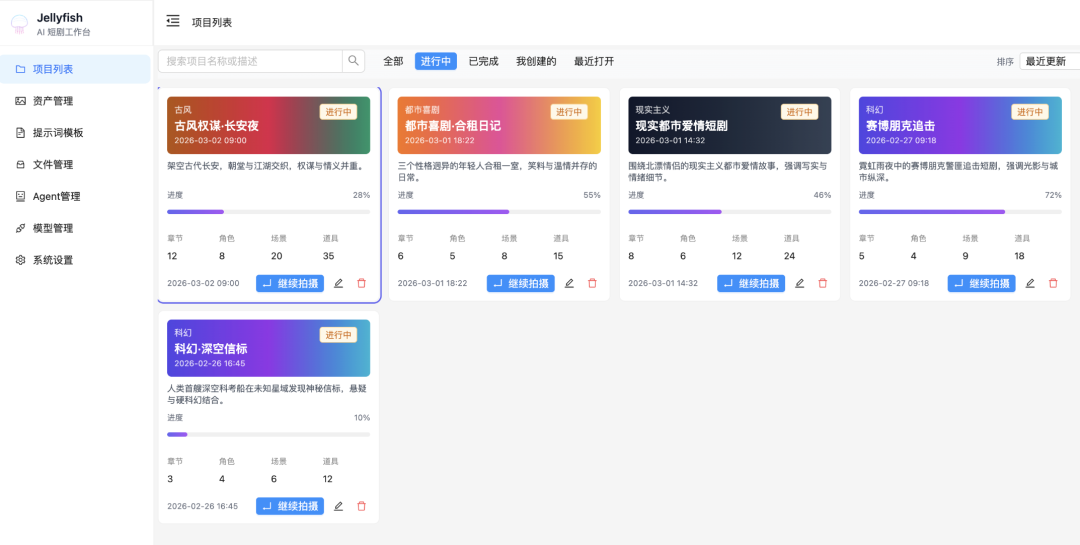
JellyFish needs significant changes after deployment
After deploying it, I found quite a few bugs that needed fixing.
Apache-2.0 is the most permissive license of the five, but unfortunately it's attached to a repository that no longer updates.
5. BeefTV: not a short-drama pipeline, but a creative workbench
2.6k stars, 83 tags, and v2.4.0 was released in the early hours of November 21—it updates frequently.
The official pitch is that it's a replacement for libTV, and for people who use common domestic public platforms, the workflow does feel more familiar.
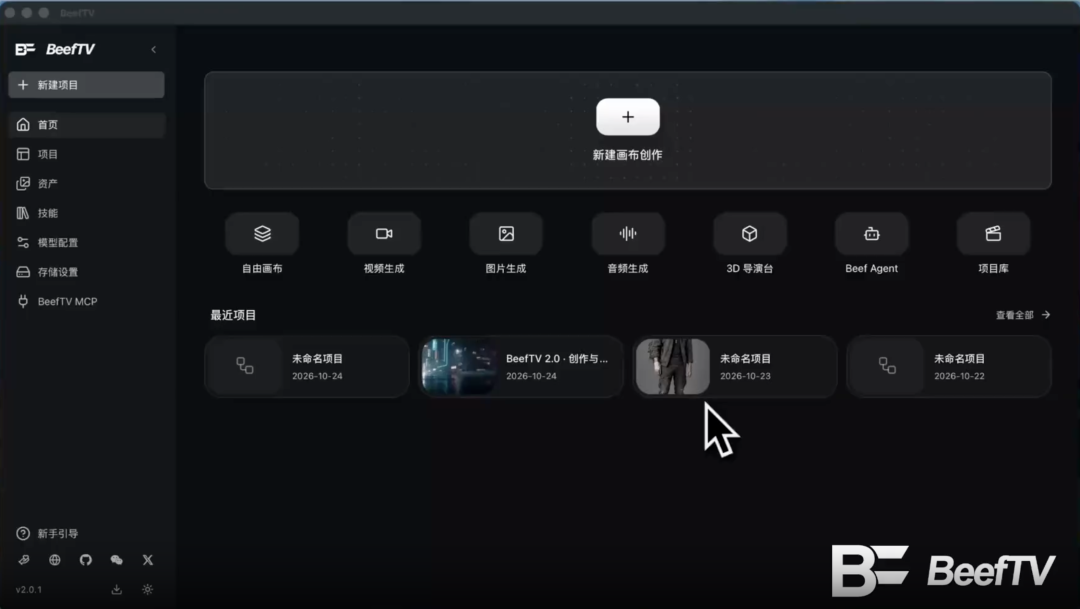
BeefTV's familiar interface
Get the positioning right: it's an "AI video creation workbench," not a "short-drama generator." Short dramas are just one of the things it can do.
The core is canvas + Agent. There's an example in the README that stuck with me: the user says only "make me a viral short drama about surviving the apocalypse," and the Agent builds 25 nodes and 48 connections on the canvas by itself—from script structure and an 8-shot storyboard to characters, scenes, first frames, video, and Chinese voiceover. Everything stays on the canvas and remains editable.
But after deploying it myself, I didn't manage to get this feature working.
There's also a Skills marketplace (packaging creative methods as installable skills), workflow templates (saving working steps for reuse), and MCP integration (Claude Code, Codex, and Cursor can all connect to the canvas).
It's built on top of open-ai-canvas, the upstream license is clean, it's local-first, and desktop performance is genuinely good.
But read the license carefully: it isn't open source in the OSI sense; it's "source-available."
- What you can do: deploy it yourself, do internal custom development, use it to make films and sell them.
- What you can't do: commercial resale, white-label resale, paid deployment, or providing hosted services—all of these require prior written permission.
The good news is that "use it to make films and sell them" is explicitly allowed. For a short-drama studio, that's enough; for someone who wants to build a SaaS on it, it isn't.
It also lacks huobao's rigid "script → episodes → stitch and export" pipeline, so you have to build the short-drama workflow yourself on the canvas. More freedom, but also a higher learning curve.
6. printfilm: a self-hostable short-drama SaaS
7.2k stars, MIT, v0.3.0, a two-month-old project.
Its completeness doesn't feel like a 0.3.0: a user-facing app + admin backend (users, orders, templates, task center, model routing, billing, wallet), one-click Docker, images in a public registry that you can pull without logging in.
ARK_MOCK=true lets you run it empty first—you can click through the whole UI without configuring keys. That's a very friendly design for evaluating tools.
Two product lines: short dramas (outline → episodes → script → storyboard → assets) and short-video marketing (style → copy → storyboard → generation → compositing).
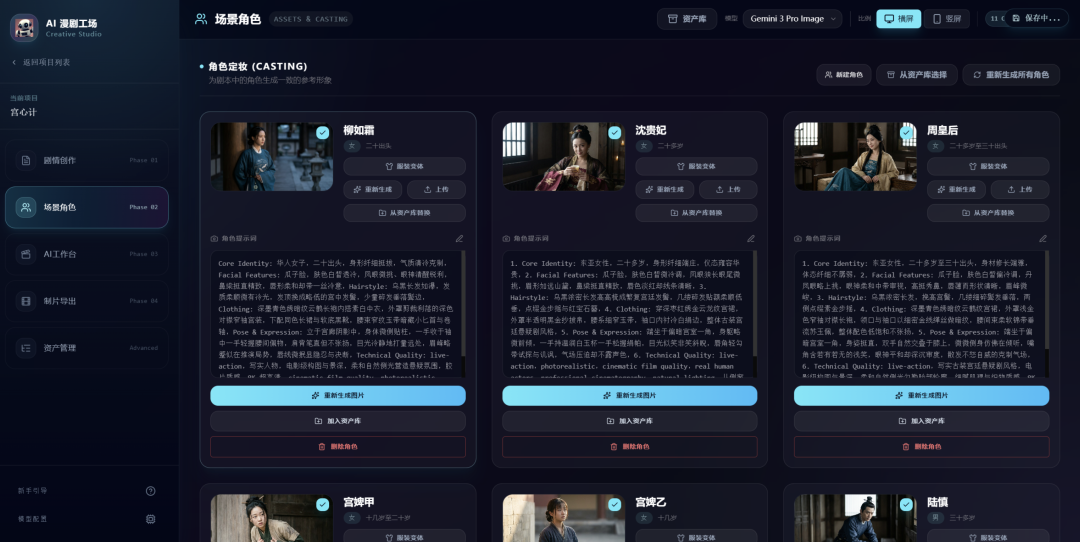
printfilm's workflow is more traditional
The problem is upstream lock-in.
The open-source version is hard-coded to TokenFree New API; base_url is hard-coded in the config file (backend/app/config.py). In theory, any OpenAI-compatible gateway should work, but the video model pipelines are written around Seedance parameters—switching providers means changing code, not configuration.
It feels more like "the official open-source frontend for a particular API platform" than "a neutral self-hosted tool." Before using it, think carefully about whether you're willing to be locked into that upstream.
7. Three truths that matter more than features
1. The license matters more than features
Five projects, four license types:
| License | Projects | What it means |
|---|---|---|
| MIT | Toonflow, printfilm | Most permissive: commercial use, custom development, and SaaS are all fine |
| Apache-2.0 | Jellyfish | Equally permissive, but the project is abandoned |
| CC BY-NC-SA 4.0 | huobao-drama | Commercial use prohibited; written permission required |
| Source-available | BeefTV | Selling works is fine; selling software/hosting requires permission |
The first step in choosing a tool should be opening the LICENSE, not looking at screenshots. This step can save you 80% of the trouble later.
2. They're all pipeline tools; they don't solve image quality
The underlying logic of all five is highly consistent: character turnaround → reference image/first frame → image-to-video → stitching.
The so-called "one-sentence finished video" is still demo-level. Consistency depends on an asset library + human review, the bad-take rate depends on reruns, and final quality depends on the models you connect.
Tools can handle 80% of the grunt work, but they can't replace the 20% that requires aesthetic judgment.
3. Factor cost into the budget
At public partner channel pricing, video generation costs roughly 0.05 to 0.09 yuan per second.
A three-minute film needs 180 seconds of footage; one generation costs 10 to 17 yuan. With a 3–5x bad-take rate, the model cost for a 3-minute short drama is roughly 30–50 to just over 100 yuan, not including TTS, images, or labor.
That number determines whether batch production is actually worth it. Don't just look at the free tools—the bill is on the API side.
8. How I'd combine them
| Scenario | Combination | Why |
|---|---|---|
| Commercial short-drama production | Toonflow main pipeline + BeefTV repairs | Blockout preview sets camera positions; the canvas handles "this take doesn't work" |
| Technical evaluation / custom development | Read Jellyfish + borrow from printfilm + reference Toonflow | Entity modeling, task center, backend billing, frontend interaction |
| Just want to try | huobao desktop | Working in 20 minutes; switch after trying (non-commercial) |
| Build a public service | printfilm | Closest to SaaS, but solve upstream lock-in first; rule out BeefTV |
A bit more detail:
Commercial short-drama production: Toonflow runs the main pipeline, blockout preview sets camera positions, and you generate shot by shot; BeefTV handles single-shot repairs and complex shot planning—its canvas and Agent are best suited to "this take doesn't work, do another."
Technical evaluation or custom development: Read Jellyfish's entity modeling and task center, borrow printfilm's backend and billing structure, and reference Toonflow's frontend interaction. Put the three repositories together and you have a complete architecture textbook.
Just want to try: huobao desktop, get the full workflow running in 20 minutes, first confirm "is this workflow worth investing in," then decide whether to switch to a commercially usable option. Remember it's non-commercial; switch after trying.
Want to build a public service: printfilm is the closest, but solve upstream lock-in and multi-tenancy first; rule out BeefTV entirely, since its license doesn't allow hosted services.
9. If you only remember three sentences
- For commercial projects, start with Toonflow: MIT + blockout preview + still shipping daily, and there's no competitor right now.
- huobao is good for testing the waters, not for monetization. CC BY-NC-SA means "fine to play with, not to make money."
- Jellyfish's code is worth reading, but don't put it in production—it hasn't been updated in seven months.
Appendix: repositories and original licenses
| Project | Repository | License file |
|---|---|---|
| Toonflow | https://github.com/HBAI-Ltd/Toonflow-app | MIT |
| huobao-drama | https://github.com/chatfire-AI/huobao-drama | CC BY-NC-SA 4.0 |
| Jellyfish | https://github.com/Forget-C/Jellyfish | Apache-2.0 |
| printfilm | https://github.com/yi1108/printfilm | MIT |
| BeefTV | https://github.com/glanderness/BeefTV | BeefTV Source Available License 1.0 |
Note: This assessment is based on public information as of 2026-11-21 (READMEs, directory structures, LICENSE files, releases, and issues). I did not fully deploy and verify all five projects one by one; star counts and version numbers change over time, so recheck before citing them.