Crashed on Launch Day: Behind Jev's Explosive Growth Is AI Repricing Fast Thinking
Recently, a model that "can't talk" has been flooding the global developer community. It doesn't write articles, doesn't chat, and doesn't write code; it only returns a few numbers and labels. It's called Jev, from TypeSafe AI, founded by former OpenAI researcher Diogo Almeida.
Recently, a model that "can't talk" has flooded developer communities worldwide.
It doesn't write articles, doesn't chat, and doesn't write code — it just returns a few numbers and labels, like "urgency 96%" or "category: billing issue."
In the 36 hours after launch, 140,000 developers poured in, and Vercel called it "the fastest-adopted paid model in history." Registration is open now, but usually right after you submit your signup email you get a notice that the slots are already gone.

It's called Jev, from TypeSafe AI, founded by former OpenAI researcher Diogo Almeida.
The name comes from the 19th-century economist Jevons, nodding to the "Jevons paradox" — when the cost of using a resource collapses, demand ultimately soars.
Why do developers buy in? Because it's fast, because it's cheap, because it's stable.
LangChain's test is telling: they had Jev, GPT-5.6 Terra, and Claude Sonnet 4.6 evaluate the same batch of Agent execution traces, repeated 100 times.
Across 500 judgments, Jev matched the human standard exactly, with variance only about one ninety-second of Claude's. On cost, Claude spent $28.17; Jev spent $0.34.
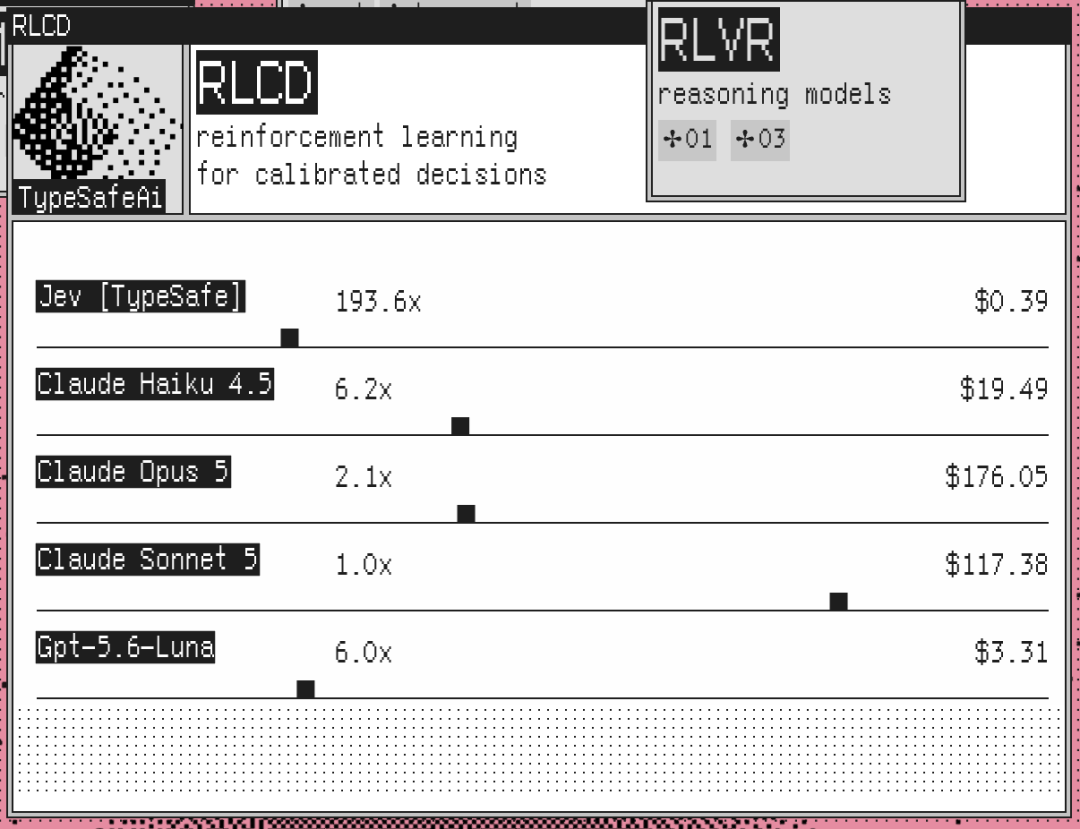
This isn't a contest over "who's smarter" — it's a question of task fit.
Today's large language models are essentially "text generation machines." You ask which department an email should be forwarded to, and it generates a paragraph, and then the software still has to parse out the words "finance department." Maybe only those four words are ever used; the rest is written for a human to read, while what calls it is code.
What Jev does is simple: write the answers in advance and let the model just pick.
Its API has only three question types:
- Choice (pick one from preset options)
- Score (rate on a given scale)
- Noul (a yes/no judgment that returns a probability value).
No generation, no explanation, no chain of reasoning.
Because it skips token-by-token generation, its speed is in milliseconds: 70 to 500 ms end to end, 194 times faster than the fastest frontier models. Output is free, input is just $0.042 per million tokens, and unit cost can be as low as one four-hundredth of a large model's.
In complex AI Agent tasks, a huge number of model calls are just routing, classification, validation, and other jobs with a limited answer space. Having a hundred-billion-parameter model do these is like using novel-writing ability to fill in the blanks.
In Thinking, Fast and Slow, Kahneman distinguishes two cognitive systems: System 1 is fast, intuitive, automatic; System 2 is slow and deliberate. The LLM race of the past two years has essentially been about strengthening "System 2." But real intelligence has never been System 2 alone. When you're driving and judge "is the car ahead about to change lanes," you don't need to stop and write out a chain of reasoning.
Thinking, Fast and Slow: the intellectual spark behind DeepSeek R1
A more practical Agent architecture for the future is likely to be layered:
Complex planning goes to frontier models, ordinary reasoning goes to lightweight generative models, high-frequency atomic judgments go to decision models, and deterministic logic stays with traditional code.
Within days of Jev's release, quite a few teams in the community open-sourced cross-platform reimplementations that run on ordinary machines and complete browser automation tasks entirely offline.
That's also a hint: fast-thinking capability may not need the cloud.
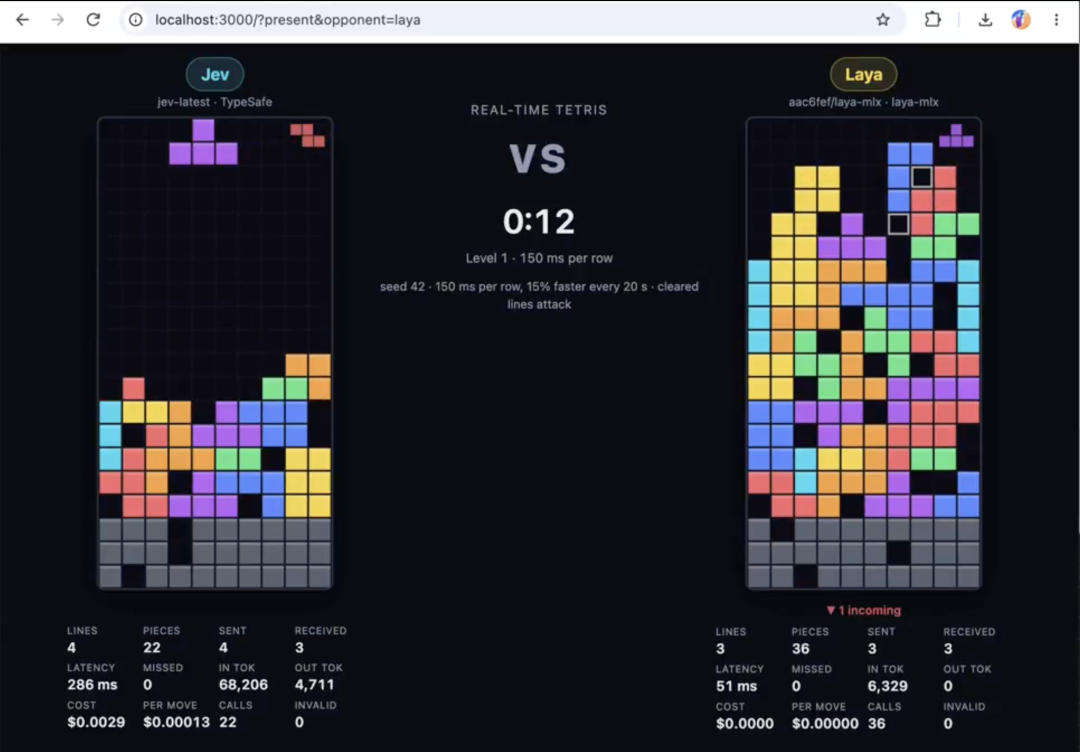
An open-source Tetris test of Laya against Jev, which ended up slightly behind Jev
Jev's most valuable lesson is that it validated an architectural idea: AI shouldn't be a monolith. It may not replace anything, but it has pushed the cost structure and response speed of AI systems into a new order of magnitude.
What enterprises actually need isn't "smarter" but "smart enough, cheap, fast, stable." It has boundaries too: it can't conjure things from nothing, it doesn't explain itself, and its judgment doesn't crush large models. Its value is in being cheap, fast, and stable.
When the cost of judgment gets low enough, software will grow a large number of "intelligent nodes" that didn't exist before — nodes that don't need to "think hard," just an answer that's cheap, fast, and stable enough. That's where the Jevons paradox is genuinely worth looking forward to in AI.
Jev doesn't have open-source models yet, but the team has released a companion Agent Skill that plugs it straight into existing workflows.
Project links
- Official site and docs: https://typesafe.ai/, docs at https://docs.typesafe.ai/
- Agent Skill repo: https://github.com/typesafe-ai/skills
How to use it
If you use Claude Code, just add a plugin marketplace:
claude plugin marketplace add typesafe-ai/skills

claude plugin install typesafe@typesafe-ai
Other Agents go through skills.sh:
npx skills add typesafe-ai/skills --skill typesafe-ai
Once it's installed, just tell the Agent what you need, for example: "Use TypeSafe to route tickets by department, and hand the uncertain ones to human review." In Claude Code you can also call /typesafe:typesafe-ai explicitly.
The repo already has 1.7k stars and 89 forks, and it's still climbing.
Of course, developers still have to wait for API key slots to open up, or lean on the open-source community and try implementations like laya and kev.