iFlytek's Three-Front Strategy: C-End Sprint, G-End Drag, and an AI Veteran's Breakout
[Disclaimer]: All data in this article comes from financial reports, and all views are personal opinions. This does not constitute investment advice.
[Disclaimer]:
All data in this article comes from financial reports. All views are personal opinions and do not constitute investment advice.
My own cultivation is lacking and my abilities fall short, so what I see may be nothing but surface phenomena. Do not take it as truth or as the real state of things.
When it comes to domestic AI companies, the ones that make people sigh with regret, apart from Baidu, are iFlytek. This company, once the leader in speech recognition, has been through a development journey that invites a lot of rueful reflection.
The growing pains of transformation
As a pioneer in the domestic speech recognition field, iFlytek once held more than 70% of the Chinese speech market. Yet in 2018 the company unexpectedly got caught up in a "property speculation scandal," with reports that it had bought large amounts of real estate in Hefei, Suzhou and elsewhere, drifting away from its core technology business. It was not until 2022, when ChatGPT set off the large-model boom, that the company woke up as if from a dream and resolved to return to the technology R&D track.
The resolve behind the transformation is real enough. R&D spending jumped nearly 30% year over year in 2022, and has kept growing at a double-digit rate every year since. But this "R&D-heavy" strategy has brought obvious side effects: over the past three years, revenue has kept growing while profit has stalled.
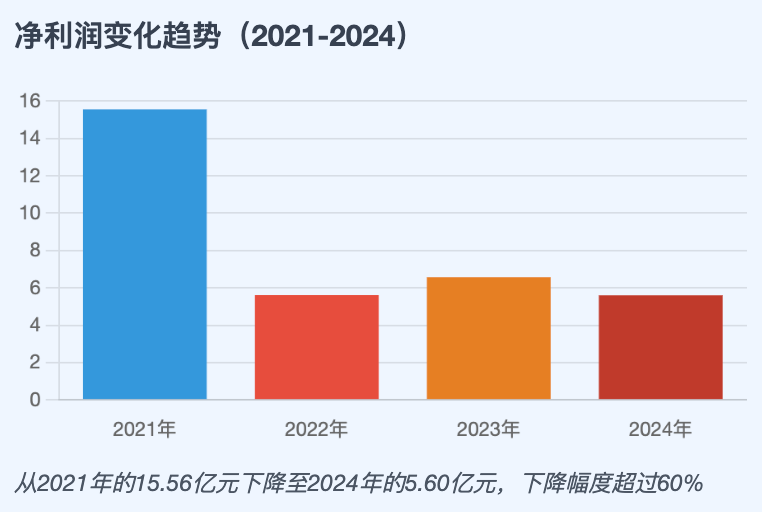
What is more telling is that R&D investment has consistently grown a little more slowly than sales expenses, while financial expenses swing up and down like a roller coaster — a sign that there may be hidden worries in how the company manages its capital.
The government-business trap
Another thorny problem comes from government business (the G-end).
In late 2016 the company proposed a "dual-wheel drive" strategy spanning to-B and to-C business, which by 2024 had evolved into "excel at the C-end, strengthen the B-end, be selective at the G-end." At the shareholders' meeting, management went out of its way to stress that it would give priority to working with local governments in good fiscal health. That seems to hint that the company is finally ready to face up to its most stubborn old problem, the G-end business.
The details of the financial reports show signs of the adjustment: the smart city business, once ranked second, had dropped to fourth by 2024, its revenue share shrinking from 29.46% in 2020 to 15.49%. In addition, the teaching business within smart education, which also belongs to the G-end (1.46% of revenue in 2023), was quietly deleted.
But the most lethal problem of the G-end business — collecting payment — remains unresolved: every year the company loses money in the first three quarters and relies on fourth-quarter collections to "make its numbers," and this seasonal swing keeps investors on edge.
The accounts receivable problem is especially stark: it has stayed above 30% since 2022, climbing to 35% in 2024.
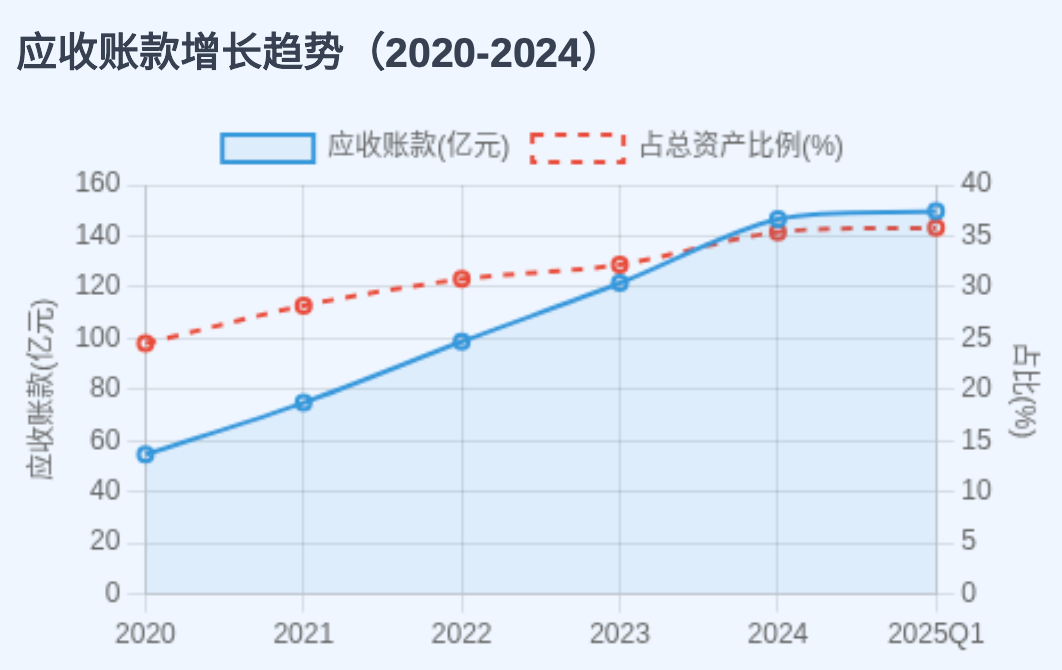
In 2024 the company recognized 1.014 billion yuan in bad-debt impairment losses, up 277 million yuan year over year.
Although the financial report stresses that "accounts receivable mainly come from high-quality customers," investors clearly are not buying it — some even suggest "transferring the receivables to a third-party asset management company."

Breaking out on the C-end
Still, a glimmer of dawn is appearing: free cash flow in the first quarter of 2025 was -710 million yuan, a marked improvement on -1.38 billion yuan in the same period of 2024.
The consumer side has been particularly bright — during the 618 shopping festival, iFlytek learning machines took three of the top five spots on JD.com's sales ranking, showing strong market dominance. The newly released interim earnings forecast also shows net profit growing substantially; these positive signals may herald a turning point.

The developer platform's growth also deserves attention, with its revenue share rising steadily from 23% in 2020 to 33% in 2024.
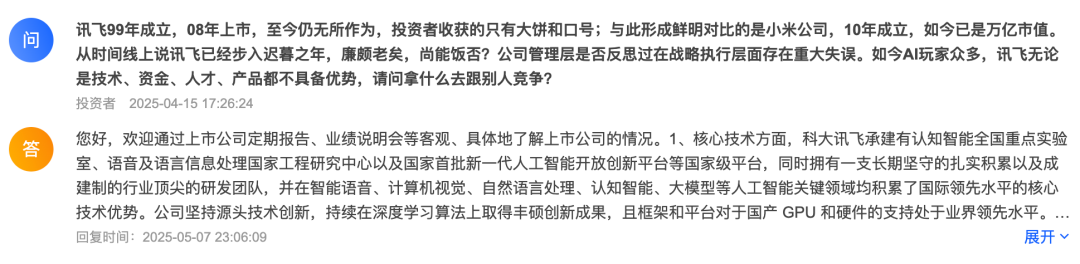
Compared with other AI companies that trumpet "world's first" at every turn, iFlytek comes across as more pragmatic and low-key. That is why it gets relatively little buzz. But in a fiercely competitive market, this "good wine needs no bush" strategy sometimes cedes the stage to rivals who are better at drumming up attention — a case of bad money driving out good.
Investors have voiced exactly this concern on its official website.


The road to a breakthrough
With the AI arms race hotter than ever, can iFlytek revive its fortunes on the strength of its deep technology accumulation and a business structure that is being reshaped?
Perhaps, as the old saying goes: a long road tests a horse's stamina, and time reveals the true picture.
We hope this veteran AI company can break through the encirclement and shine once more.