Stars Jump 12K in 3 Days: Hermes Agent Is Ready Out of the Box and Worth a Try
Hermes Agent is an Agent better suited to programmers: ready out of the box, with more complete tooling. Its star count jumped 12K in 3 days, and it's still accelerating.

When I first saw Hermes Agent this Monday, its GitHub star count was still sitting at 26K. Three days later, today, it has overtaken every lobster-claw-style claw Agent and reached 38K (40K by the time I finished writing). And judging by the trend, growth is still speeding up.
What is Hermes Agent?
The first reaction to the name Hermes is the luxury brand Hermès. But Hermes is also the Hermes of Greek mythology—the messenger between the realm of the gods and the world of humans. I'd guess the authors of Hermes Agent meant to borrow the name to convey "messenger between people and AI."
The team behind it, Nous Research, is a small company, but it has released its own large models—Hermes 3 (built on LLaMA 3.1) comes in 3B, 8B, 70B, and 405B variants—so its capabilities are not to be underestimated.

Hermes Agent's official tagline is The agent that grows with you—an Agent that grows alongside you.
With traditional Agents, every conversation starts from zero, whereas Hermes reviews, summarizes, and updates its own memory and skills every time it finishes a task. Using it next week and using it this week are two different tools.
Compared with OpenClaw, Hermes takes a different road—it doesn't emphasize multi-Agent orchestration or an ecosystem skill marketplace, but focuses on perfecting one thing: "an AI colleague that accompanies you long term."
Core features and my honest impressions
1. Ready out of the box, no slow taming required
Anyone who uses OpenClaw knows the first thing you do is configure SOUL.md and USER.md, hunt for suitable skills, and tame it gradually. There's nothing wrong with that, but if all you want is a capable assistant, the bar is a bit high.
Hermes runs the moment you install it. It ships with a mature memory architecture (MEMORY.md, USER.md, SOUL.md), and its built-in skill system already covers the main day-to-day development scenarios. You don't have to be a "tamer" to get good use out of it.
For someone like me, who doesn't want to fiddle and just wants AI to actually help get work done, that difference is crucial.
Image: Hermes Agent's skill list
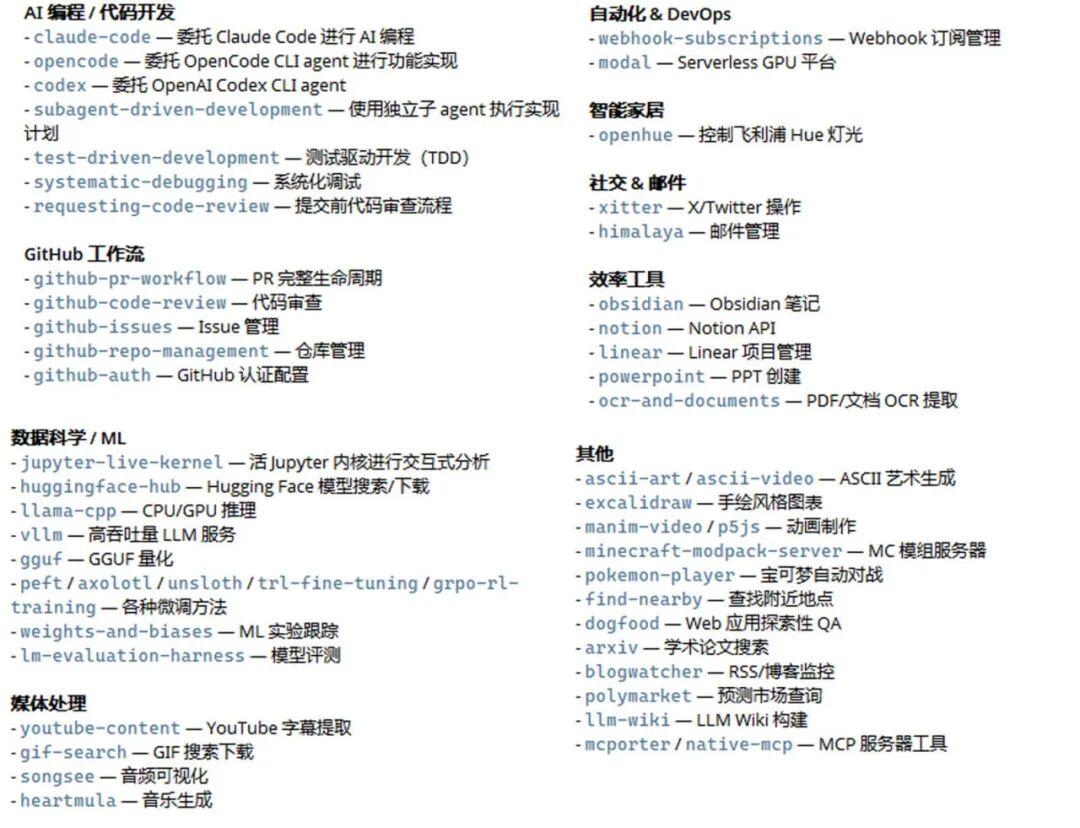
2. Programmer-friendly, with a built-in dev environment
Hermes is especially friendly to programmers. Many of the Skills mentioned above are optimized for development scenarios—not just writing code, but code review, Git operations, ML/RL research workflows, and more.
If you do data science or machine learning work and have to set up environments and run scripts yourself, Hermes's built-in ML/RL Skills are ready to use as they are.
The interaction is natural too—you describe the task, it executes, and you can see everything in between.
More importantly, Hermes can drive external coding agents: opencode, Claude Code, and Codex can all be called as its tools.
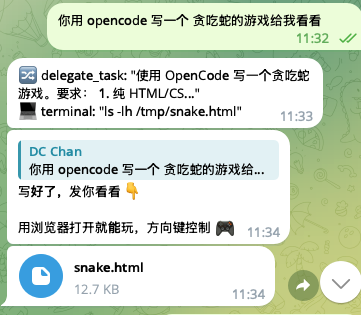
You can make Hermes the "commander": it makes the complex decisions, and the actual code writing goes to these specialized tools. The workflow flows rather than being an either/or choice. This kind of integration feels very natural to developers who are used to the CLI.
3. A transparent process, every step visible
This is where Hermes feels the most comfortable to use.
Hand Hermes a task and you can clearly see what it's doing. Researching, it shows the whole process of searching, reading, and organizing; writing code, it shows each step of creating and modifying files. Instead of waiting for it to finish and handing you a black-box result, it's livestreamed the whole way.
Image: the AI browsing websites while looking things up:
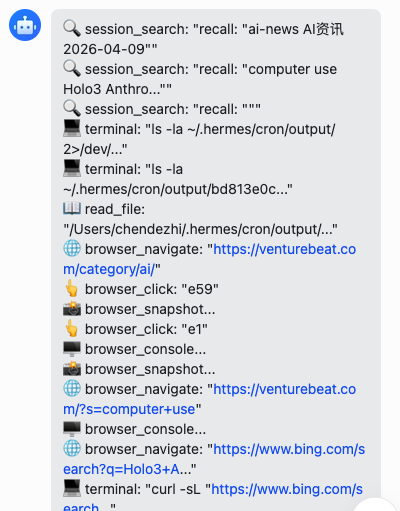
OpenClaw is more of a black box here—you issue a command, it executes, and until the result appears you have no idea what happened in between. I can't say which is better, but Hermes's transparency makes me trust its output more, and makes it easier to step in and correct course midway.
4. Self-evolution: it really is learning on its own
This is where Hermes fundamentally pulls ahead of every traditional Agent.
Hermes has a built-in GEPA (generative experience optimization) mechanism. Put simply, after roughly every 15 tool calls it automatically pauses to review which of those 15 succeeded, which failed, and where it could improve, then updates its own skills and memory.
So far, what stands out most is its ability to update memory automatically—at the end of each conversation it actively writes important context into persistent memory, and recalls it accurately the next time a related topic comes up. This isn't a simple conversation summary; it's genuine knowledge accumulation.
As for auto-generating skills, I haven't used it long enough to trigger that yet. But the mechanism is already there—when it judges that a task pattern is worth codifying, it writes a Skill itself. That gives me high hopes for how it will perform down the road.
Installation and usage
Installation takes a single command:
curl -fsSL https://raw.githubusercontent.com/NousResearch/hermes-agent/main/scripts/install.sh |bash
Before you start, it's best to sort out your network first:
GitHub clone hangs, pip gets stuck, brew spins forever? One guide sorts it out
⚠️Note: on Windows it needs to run under WSL2.
Setup
Once installed, restart your terminal.
Similar to openclaw, setup happens on the command line:
# 配置所有设置
hermes setup

# 配置单个设置项
hermes model       # 选择大语言模型
hermes tools       # 选择你需要的工具

# 诊断问题
hermes doctor      # 有问题可以使用此命令进行诊断
As for models, the domestic open-source ones—Zhipu GLM, Moonshot Kimi, and MiniMax—are supported by default. Other providers work too, as long as they're compatible with the OpenAI API.
Connecting messaging tools
See the official docs and configure it yourself, or let an AI Agent set it up for you:
Feishu:
https://hermes-agent.nousresearch.com/docs/user-guide/messaging/feishu
DingTalk:
https://hermes-agent.nousresearch.com/docs/user-guide/messaging/dingtalk
WeCom:
https://hermes-agent.nousresearch.com/docs/user-guide/messaging/wecom
Launching
You can use it two ways: a command line like Claude Code's, or chat tools the way you would with OpenClaw:
# 通过命令行 CLI 使用
hermes

# 通过通讯工具使用
hermes gateway
Who it's for:
- Anyone who wants an AI assistant that genuinely remembers you and keeps growing
- Programmers who want AI to help with research, development, and operations
- People with an interest in AI research who want to generate training data or run RL experiments
- Anyone fed up with "goldfish-style" Agents that start from zero every conversation
Official resources:
- GitHub: github.com/NousResearch/hermes-agent
- Docs: hermes-agent.nousresearch.com/docs
After a few days with Hermes, my biggest takeaway is this: the sense of safety, the sense of stability, and the "growing with you" experience are things no previous Agent ever gave me.
The star explosion isn't a coincidence. This is exactly the kind of thing people have been waiting for.