If You Have to Build Your Own Agent, Is There a Viable Path?
For every company, building your own Agent on a local/open-source model plus local data is the better approach. Especially now that model capabilities are strong enough, that approach has also become far more feasible.
Anthropic ("Company A") is in hot water again. Put simply, every time Anthropic partners with someone, it takes their data, then builds its own application and takes their users. The better-known cases are Figma and Cursor.

Now the big domestic tech companies are moving into office-work Agents as well, and these Agents are taking over ad slots in elevators, office buildings, and internet platforms everywhere.
But for most companies, using these big-company products carries the same worry as building an application on top of Anthropic's models: the data gets taken, and you end up as the one being harvested.
So building your own Agent with "local/open-source model + local data" is the safer route. Especially now, when model capabilities are already strong enough, this path has become more feasible too.
The open-source community has thrown its support behind this as well — even big names like Andrew Ng have jumped in to build Agents.
On July 24, Andrew Ng's team released their Agent: OpenWorker.
OpenWorker official site: https://openworker.com/
A week and a bit after launch, it's already at 11k+ stars on GitHub, growing fast.
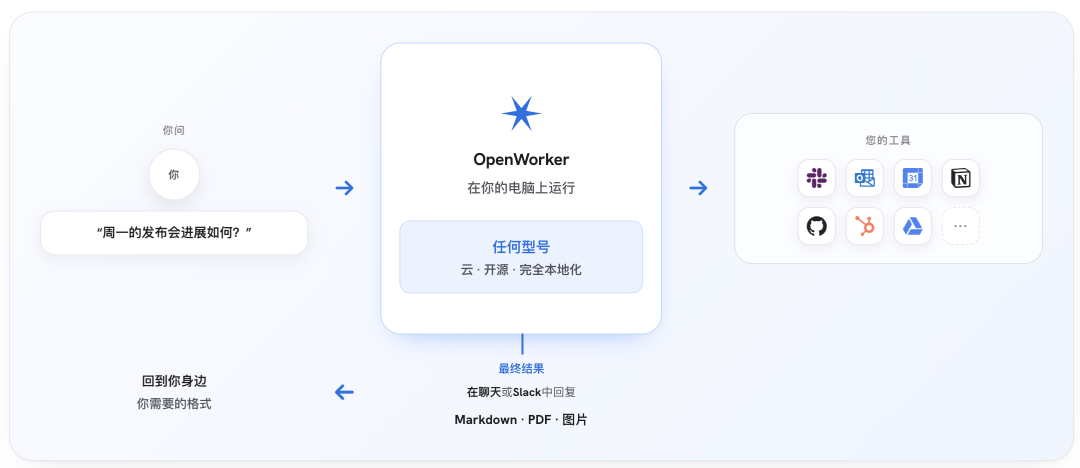
The official positioning is clear: an open-source (MIT), local-first, model-agnostic desktop AI colleague.
There isn't much functional innovation, and for users in China its ecosystem is basically built around foreign tools: Google Calendar, Notion docs... it sits a little far from our everyday productivity tools.
But the MIT open-source license (fully usable commercially) and the local-first emphasis it promotes do give us good room for secondary development. All of that makes it a solid open-source foundation — for anyone to build their own Agent on.
Speaking of building your own Agent, I suddenly thought of Linus's autobiography, which I've been reading recently; it covers how he built the Linux system.
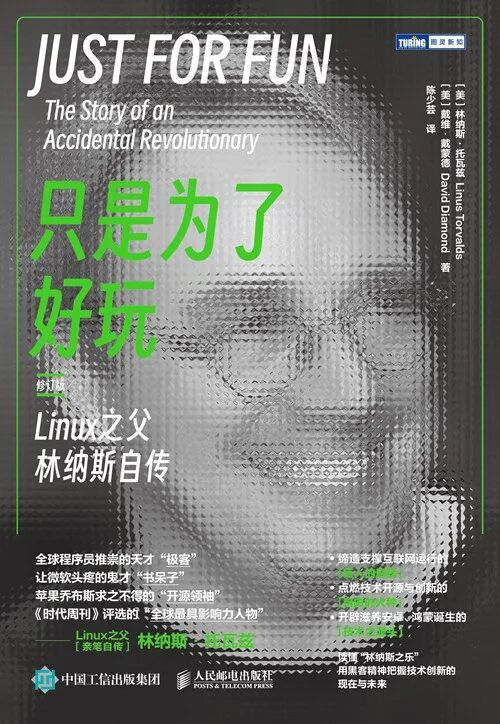
The Unix operating system Linus used back then offered only the simplest of operations — open, close, read, write, fork a process, exec a process, six in all — yet most functionality could be achieved by combining those six operations.
Those ideas also guided Linus step by step as he created his own operating system, Linux.
The Pi Agent I wrote about earlier follows the same philosophy. It gives you just 4 operations:
read, write, edit, bash
That's all. But bash is itself the bridge into the whole system — search, networking, data processing, command-line tools, all of it can be invoked through bash.
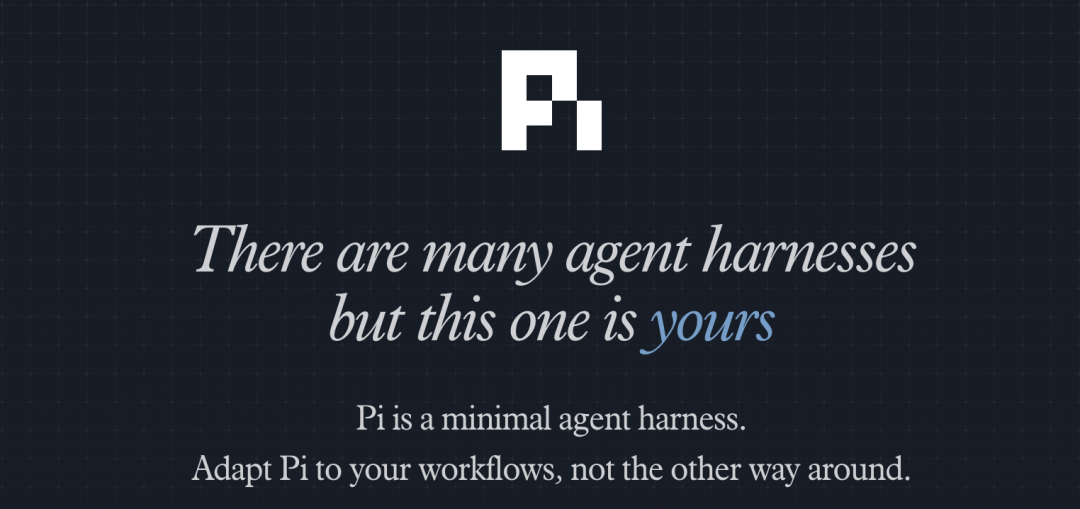
Compared with other Agents, besides supporting mechanisms like Skill, Pi also has its own extension mechanism that lets you modify the underlying layer more effectively. Through these extensions you can turn it into an Agent that suits you better.
Pi Agent packages: https://pi.dev/packages
For example, the pi-subagents package for sub-agent management, the pi-lens package with validation for multiple programming languages, the pi-web-access package that lets the Agent look things up online... these packages let you assemble a more complete coding Agent.
Seen this way, where AI Agents stand today is very similar to the early days of operating systems. More importantly, the internet's information is rich enough now, model capabilities are powerful enough, and all the tools are ready.
The Pi described above lets you customize the CLI for your own personal Agent; OpenWorker lets you customize the office GUI for your own personal Agent.
As long as you have enough resources, every company — even every individual — should try building their own Agent, to keep data out of other people's hands and build up their own moat as early as possible.