Everyone Loves DeepSeek
The standout project this week is DeepSeek-TUI, and the "AI trial of the century" between Musk and OpenAI on the other side of the world got me thinking about open source.
The standout project this week is DeepSeek-TUI.
Related links:
- GitHub: https://github.com/Hmbown/DeepSeek-TUI
- Website: deepseek-tui.com/
A terminal coding Agent written in Rust, its star count shot from a few hundred to 23,000+ in just a few days, topping GitHub's global trending list.
Developers have given it plenty of nicknames: "the DeepSeek version of Claude Code", "the domestic Codex CLI", and a friendlier one — "the whale" (the author is Hunter Bown, who calls himself the whale brother on x.com).
Although this project isn't official, it fills exactly the key missing piece in the DeepSeek ecosystem: an Agent framework truly built for DeepSeek V4.
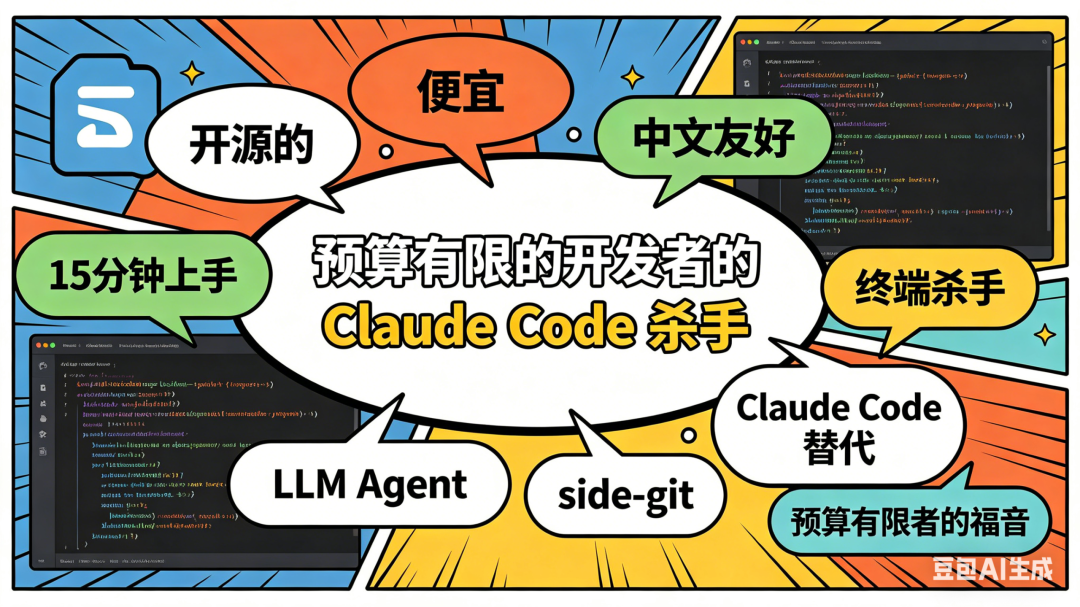
Core highlights:
- 1M token context: makes full use of DeepSeek V4's native capability.
- Three automation modes: Plan (planning), Agent (safe execution), YOLO (let it rip) — a pragmatic design.
- Smart routing (Auto Mode): first calls a low-cost model to judge how hard the task is, then decides whether to switch to a stronger model.
- Live reasoning stream: the model's thinking process is completely transparent to the user, so you can observe its analysis path and self-correction.
- Ultra-low price: about $5-10 per month, far below Claude Code (~$200) and Cursor ($20).
Compared with Claude Code and Cursor:
| Dimension | DeepSeek-TUI | Claude Code | Cursor |
|---|---|---|---|
| Open source | ✅ MIT open source | ❌ Closed source | ❌ Closed source |
| Monthly cost | ~$5-10 | ~$200 | $20 |
| Context | 1M tokens | 200K tokens | 32K tokens |
| Runtime | Single Rust binary | Node.js | Desktop app |
| Sub-agents | ✅ 16 in parallel | ✅ Supported | ❌ |
| Rollback | ✅ side-git snapshots | ❌ | ❌ |
| Chinese support | ✅ Native | So-so | So-so |
| MCP | ✅ | ✅ | Partial |
I installed it on macOS and tried it out myself. The process was very smooth:
npm install -g deepseek-tui
After installation, two binaries were ready: a 13MB deepseek and a 36MB deepseek-tui. Because the core is written in Rust, startup is fast, there are zero runtime dependencies, and it works over SSH.
The coding process wasn't especially fast, but the Chinese interface really lowered the difficulty for me:
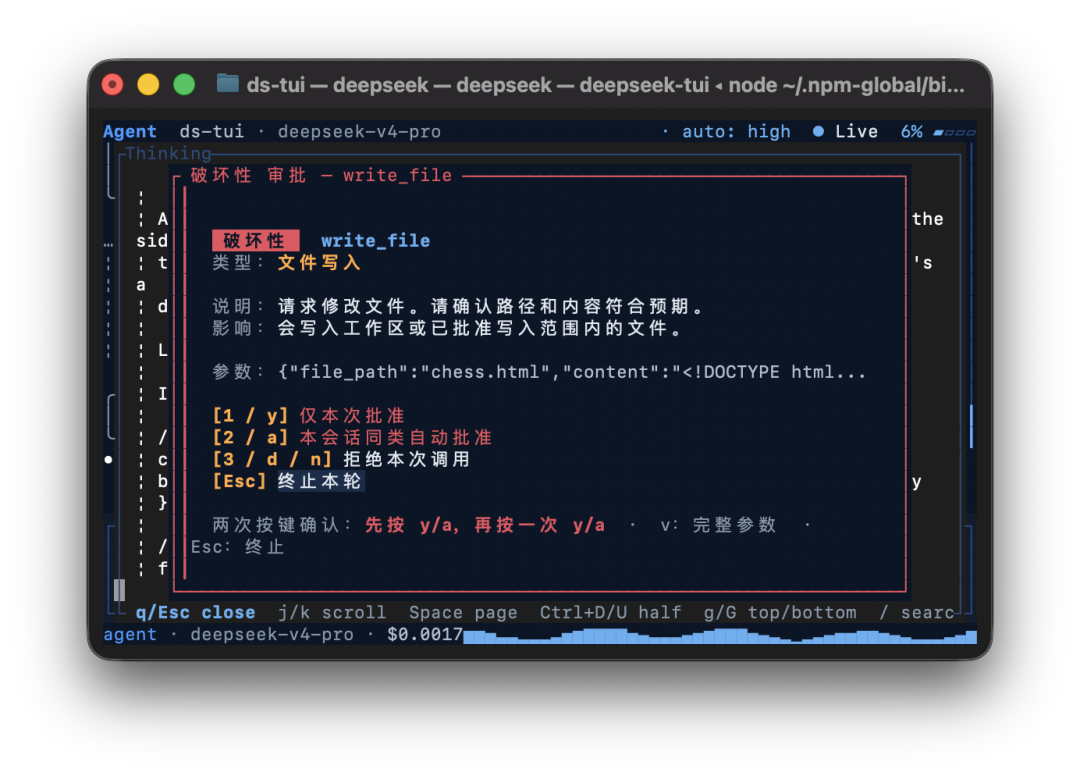
DeepSeek-TUI is worth a try if you fit any of these:
- You're a heavy terminal user, you care about cost, and you often work remotely over SSH.
- You want to make the most of DeepSeek V4's capabilities and are willing to try new tools.
How has the community responded?
Both the Chinese and overseas communities have reacted enthusiastically, calling it "a Claude Code killer for developers on a budget." Its structural advantage is that it's priced at just 1/20 of Claude Sonnet, and its billing is friendlier to non-English tokens.
The shortcomings include: the interface packs in too much information, there's still a gap when compared with official products, and behavior is unstable because of the rapid iteration.
DeepSeek's popularity has also once again sparked a discussion about open source.
Another major event this week was the "AI trial of the century" on the other side of the world — Musk's lawsuit against OpenAI is also underway, and its core demands are: restore OpenAI's nonprofit status and remove Altman and others.
OpenAI's road to "corruption" is quite ironic: from the nonprofit ideal at its founding in 2015, to Musk's departure in 2018, to setting up a for-profit subsidiary in 2019 to take Microsoft's investment, and now to preparing an IPO at an $850 billion valuation — the "Open" in its name has long been nothing but a trademark.
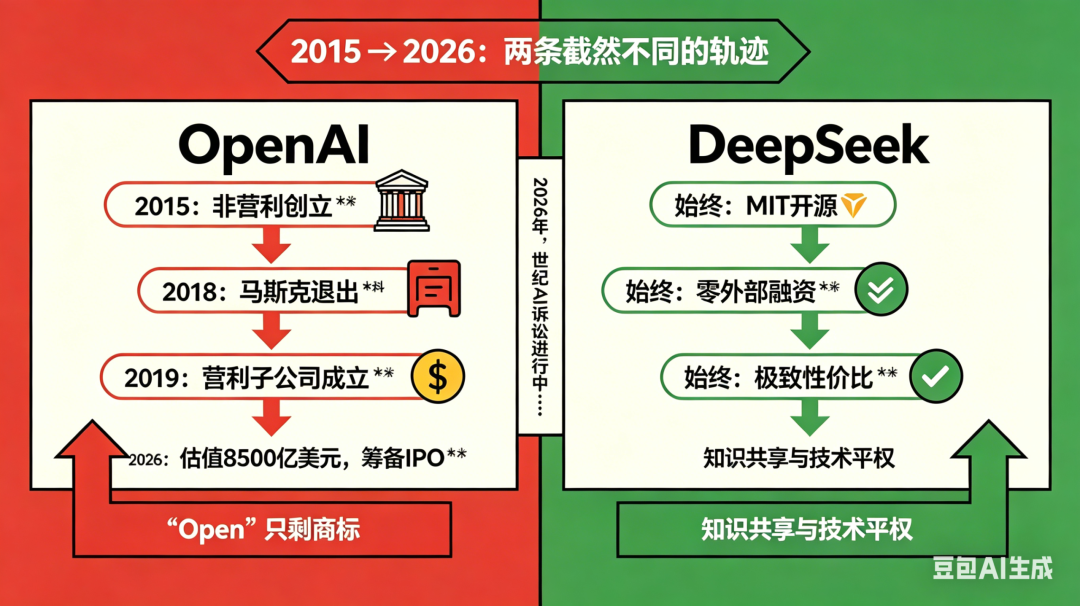
DeepSeek's story is the exact opposite:
- Genuinely open source: under the MIT license, with code, weights, and technical reports all public.
- Genuinely nonprofit: zero external funding, no commercialization pressure, and the ability to chase the AGI dream regardless of cost.
- Extreme value for money: extremely low pricing, with developers around the world voting with their feet.
The absurdity of today's AI world is that Musk is suing OpenAI to force it back to being a nonprofit while he himself founded the for-profit xAI. The romantic part is that DeepSeek has proven open source still works in the AI era: a "nonprofit" company with no business model has instead become the industry's biggest variable.
The trial's outcome is undecided, but this lawsuit reveals one truth: in the face of capital, the AI industry's "nonprofit" narrative is fragile.
But DeepSeek's existence gives us hope again — in an industry flooded with money, there are still people who choose to write code, run experiments, open-source, and share, turning the dream of knowledge sharing and technological equality into reality.