Getting Up at 4 AM Isn't for Everyone, but Early Rising Is Worth It
Thoughts after reading 4 AM Rising: getting up at 4 AM may not be a great choice, but going to bed early and rising early can give you a different kind of life.


I recently raced through the book 4 AM Rising.
The book is simple. It's mainly about why you should get up at 4 AM, how to actually do it, and what to do once you're up.
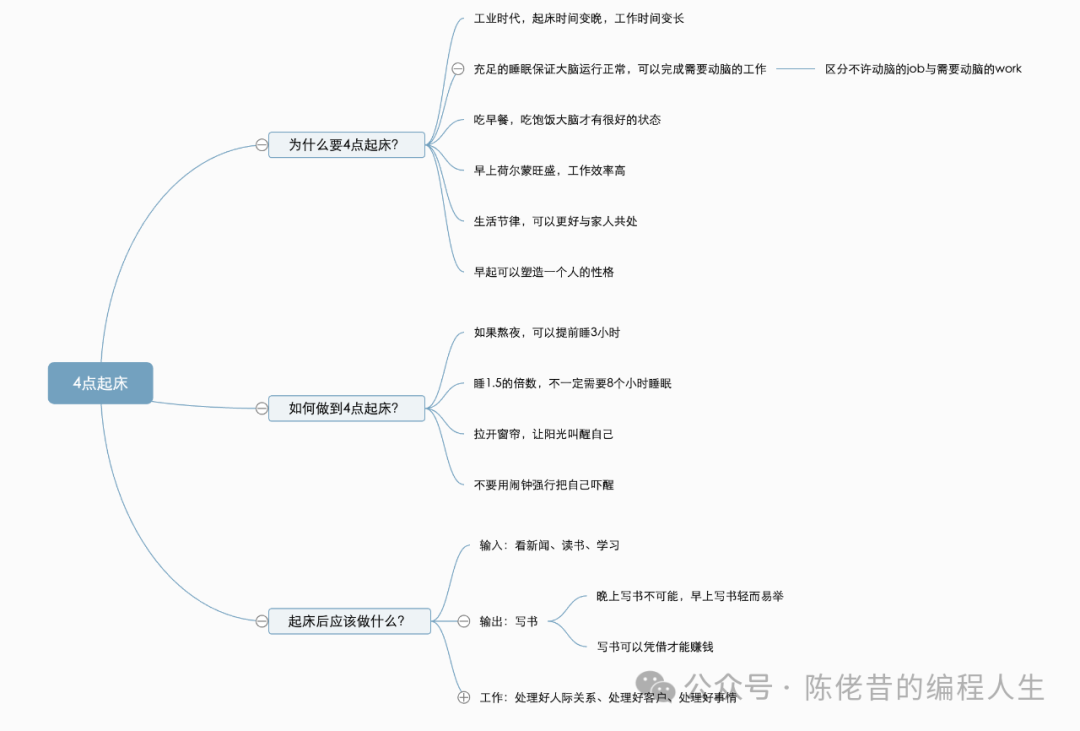
Overall I'd give it 3 stars — the kind of book you can read or skip.
I bought it as a filler order to hit the free-shipping threshold while buying other books, and I've already sold it on Duozhuayu.
So why share it anyway? Mainly because it offers a way of living.
A few years ago I heard that a "morning workers" trend had swept through Japan for a while — people who chose to work early in the morning rather than put in overtime at night. Look at the book's publication date and it lands right in that period, so it's safe to say the book has something to do with that wave.
That trend has passed now, and that itself says something. After all, for most people, getting up at 4 AM really is extremely hard.
Still, the early-to-bed, early-to-rise philosophy the book advocates is one I'd strongly recommend. Let me share a few points that struck me.
Why work early in the morning instead of putting in overtime at night
Many office workers have a habit: they can only finish their tasks by working overtime at night. The author, by contrast, argues for working early, because this is dictated by human physiology.
In fact, research shows the brain gradually shifts into rest mode after work hours, whereas getting up early lets you make full use of the hormones that activate your body, so getting these things done is easier.
Writing is the same. Some creators may think inspiration is the key to their work, but many Western writers have started advocating making writing a daily routine, using concrete methods to write rather than relying on inspiration alone. Quite a few Chinese writers have begun copying this approach — Mr. Ma Boyong, who has finished several bestselling novels, completes several novels a year, an output far beyond his peers.
My own view is this: people who work at night usually need an environment where nobody disturbs them, and the morning can achieve exactly the same thing.
I once asked some friends who go to bed early and rise early, and they all said they'd experienced a kind of calm joy — a feeling that's hard to put into words, perhaps dopamine from a long stretch of regular living. I'm the same: after a period of early nights and early mornings, I feel a special kind of contentment. If you want to try that feeling, I'd suggest sticking with early to bed, early to rise for at least a month (or even longer).
What to do after getting up early?

What activities can you do after getting up early?
Enjoying a balanced, nutritious breakfast is essential — it helps ensure you're full of energy all day. If you have a family, spending some breakfast time with them also strengthens the bonds between family members.
The book also contains many suggestions built around input and output, such as reading more and writing more. Starting to produce a lot right away may be hard for many people, but keeping a daily log is actually much more doable.
The "log" here isn't a traditional personal diary, but a form of notes that records your daily activities.
By writing a log, you can sum up what you did the day before and draw up a detailed to-do list for the day. Be clear about which tasks are important and which simply have to be done. This helps you manage your time and work arrangements better, makes sure every day proceeds in an orderly way, and helps you say goodbye to the sense of pointlessness and of being busy for nothing.
What's more, this habit also helps push forward the important-but-not-urgent tasks, so they don't get overlooked or delayed.
Should you get up early to take in information?
Since humanity entered modern civilization, the arrival of newspapers, radio, television, and the internet has pushed people into an age of information overload. If we keep passively receiving information the way we used to, in the end we'll only take in a mass of useless information.
One idea in the book that I find quite worth considering is reading the news critically. When reading stock-market and financial news, for instance, you should question the relevance of the share price to that piece of news.
Of course, this seems fairly demanding on the individual: you have to put your own brain to work every single time.
My own approach is more radical: I deleted all my news apps, including every ByteDance app, Douyin among them. The push mechanics of these apps are very strange — they deliberately blur the timeline, so what you see might be old news from years ago. Later, many apps adopted a similar way of pushing content.
So I simply blocked all news clients.
Someone might ask: then where do you get your news? In fact, in daily life colleagues will naturally discuss important news events over a tea break or a meal, so there's no need at all to worry about missing anything important.
What about staying up late?

The book's methods for coping with late nights seem genuinely useful to me.
We all know that as programmers or white-collar workers, the occasional late night is unavoidable, and one late night can leave you in poor shape for the next two or three days, feeling foggy.
The book offers a good method: if you know you'll be up late, sleep for 3 hours first, then get up and carry on. This can ease the negative effects of a late night to some extent.
That's about all I have to say about the book's content. Most of the rest is the author's personal sharing about the workplace, which doesn't suit me and didn't resonate much. So I'll stop here.
Thanks for reading.