Weekly Notes 18: Learning to Code Gently with Easy Vibe, Then Hearing a Legend Talk Engineering — This Week Healed Me

AI coding tools are increasingly leaning toward "generate the requirement in one sentence" — so is learning to code still necessary?
I think it still is. Engineering ability remains irreplaceable. If your output is only for your own use, that's fine; but once more complex scenarios or commercial projects are involved, these fundamentals are still unavoidable.
That said, the learning path can be a lot more relaxed. There are plenty of learn-to-code projects on Github, and you can certainly find traditional systematic courses (for example, the free self-study guide to computer science at https://github.com/ossu/computer-science).
But if you find traditional courses too dry and want to start from a relaxed and fun angle, I recommend this project:

Datawhale's Easy-Vibe Website: 🌐 https://datawhalechina.github.io/easy-vibe Designed for programming beginners: start from zero, learn while playing, with the atmosphere dialed all the way up.
If you're a veteran programmer or already have some fundamentals, you can jump straight into these beginner-to-intermediate hands-on tutorials and build real projects. The examples here are all practical, and you can pick whichever fits your needs:
| Project | Description |
|---|---|
| 🎬 Let's Make a Hogwarts Portrait | A fun front-end project, great for getting started |
| 📝 AI Marketing Copy SaaS | A full-stack project that combines AI capabilities |
| 📋 Online Exam and Management System | Hands-on Express backend |
| 🎨 Modern AI Image Generation SaaS | Front end + AI-generated images |
| 🤖 A Dify-like Agent Platform | Build your own AI Agent platform |
| 🗺️ Smart Travel Planning Agent Platform | Travel planning + AI agents |
| 🎥 Spring Boot Movie Recommendation System | Hands-on backend recommendation system |
| 🛒 Fresh Grocery E-commerce Microservices System | Hands-on microservices architecture |
| 🚦 Go Traffic Data Analysis Platform | A Go data analysis project |
Also, if you've only ever worked in a single role and want to understand front end and design, or backend and databases, the tutorials have all been streamlined so you can get up to speed faster.
Back to engineering ability. What actually counts as real engineering ability? This week I heard Kent Beck discuss a topic on a tech podcast, and it gave me a great answer:
🔗 Kent Beck: In the AI Era, Why the "Human Part" of Software Engineering Is Harder Than the Code (Chinese translated version)
https://www.xiaoyuzhoufm.com/episode/6a46c7c49d2f57436841aea9
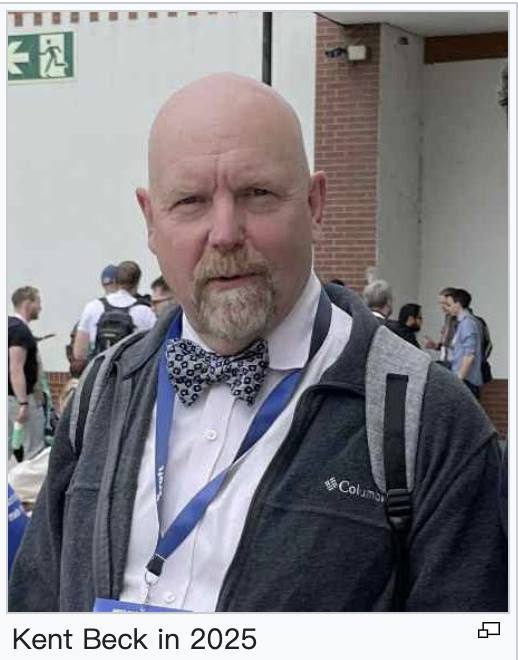
The guest, Kent Beck, is a legend in software engineering: creator of Extreme Programming (XP), a pioneer of test-driven development (TDD), co-creator of JUnit, and the first signatory of the Agile Manifesto. He is 60 this year and has been in the industry for over 40 years, witnessing the whole arc of software engineering from its birth to its development.
For the first time on a podcast, Kent Beck walks through his entire career from entering the industry in the 1970s to today: from his early exposure to Smalltalk, to inventing test-driven development (TDD) and Extreme Programming (XP), taking part in drafting the Agile Manifesto, and his "lost decade" at Facebook and his rebirth there.
But this conversation is far more than nostalgia. Now that AI coding tools are sweeping the industry, Kent uses his nearly 50 years of perspective to give extremely candid, information-dense answers to the following questions:
- "Will programming disappear?"
- "The crisis of trust in the AI era"
- "Why has Agile gone bad?"
- "Why doesn't TDD work?"
Honestly, after listening, my anxiety was gone.
What struck me most was this: it turns out that early in the history of programming, as object-oriented programming rose, the same argument that "there will be fewer and fewer programmers" already appeared — and in hindsight that was obviously wrong.
We always struggle to imagine the future. Facing change and turning points, anxiety magnifies fear and pessimism gets the upper hand.
But as that widely circulated saying goes: "Pessimists are right; optimists move forward." — pessimism avoids mistakes, optimism drives progress, and possibility is found amid uncertainty.
Rather than being anxious about whether AI will replace us, it's better to hear what this veteran programmer of nearly 50 years has to say. This one podcast episode may be more useful than chasing ten AI news articles.