Is Publishing Docs on GitHub Open Source?
"Does throwing docs up on GitHub count as open source?" Three years ago, the answer to that question was almost certain: no. Open source specifically meant "source code."
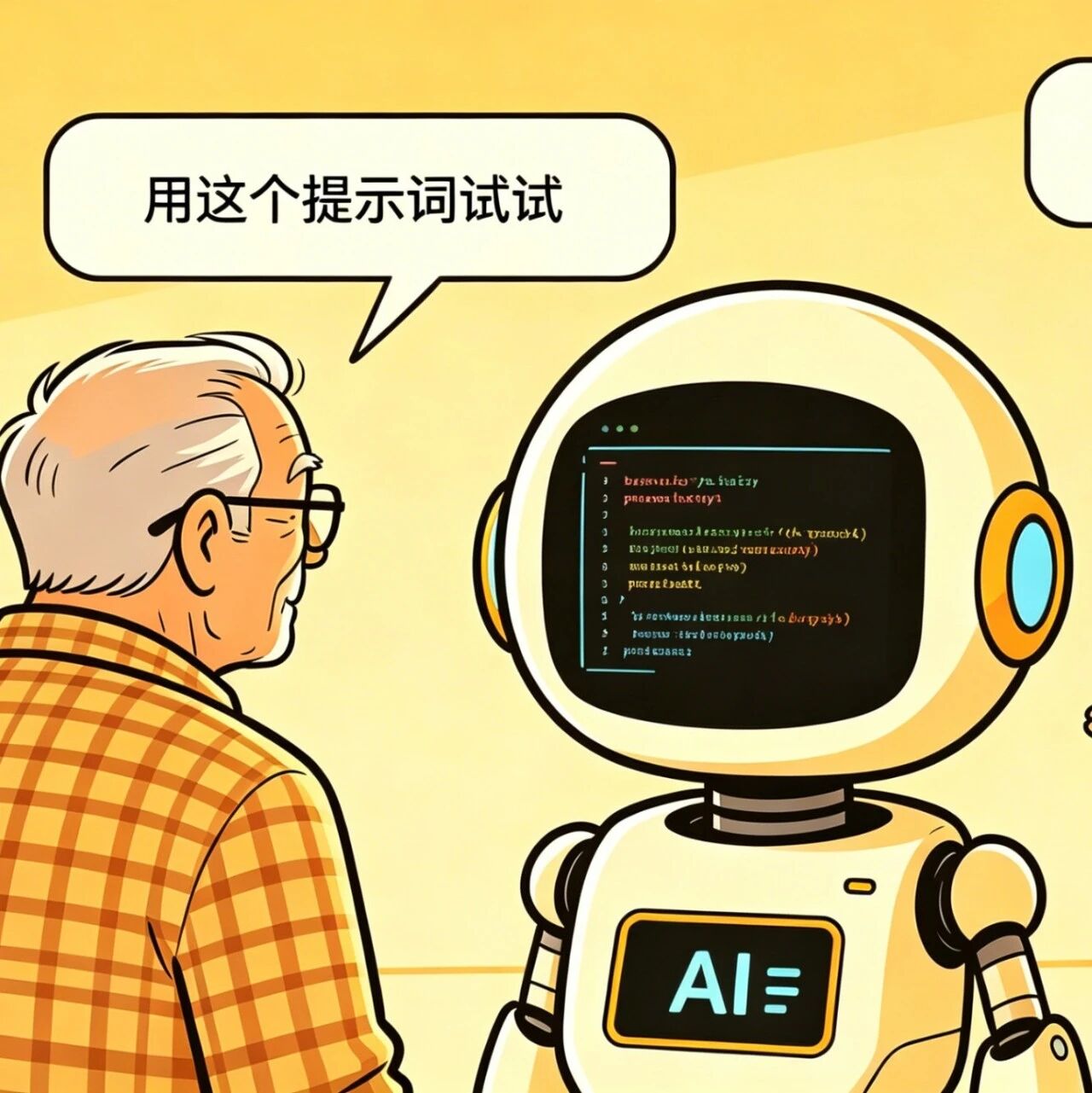
"Does throwing docs up on GitHub count as open source?"
Three years ago, the answer to this question was almost certain: no. Open source specifically meant "source code."
But today, when AI Agents can read Markdown instructions directly and carry out tasks, and when projects that contain nothing but a prompt can "generate" a complete macOS app start appearing on GitHub, we have to re-examine a boundary we long took for granted.
The first thing to break the idea that "open source only means source code" was the rise of more and more Skills. By combining natural language with code, they let an Agent complete complex tasks.
Community feedback confirms this too — on every major platform, when people share a Skill they all call it "open source," and nobody argues over whether it's a .py file.
What really opened my eyes was a project like this:
https://github.com/yetone/voice-input-src
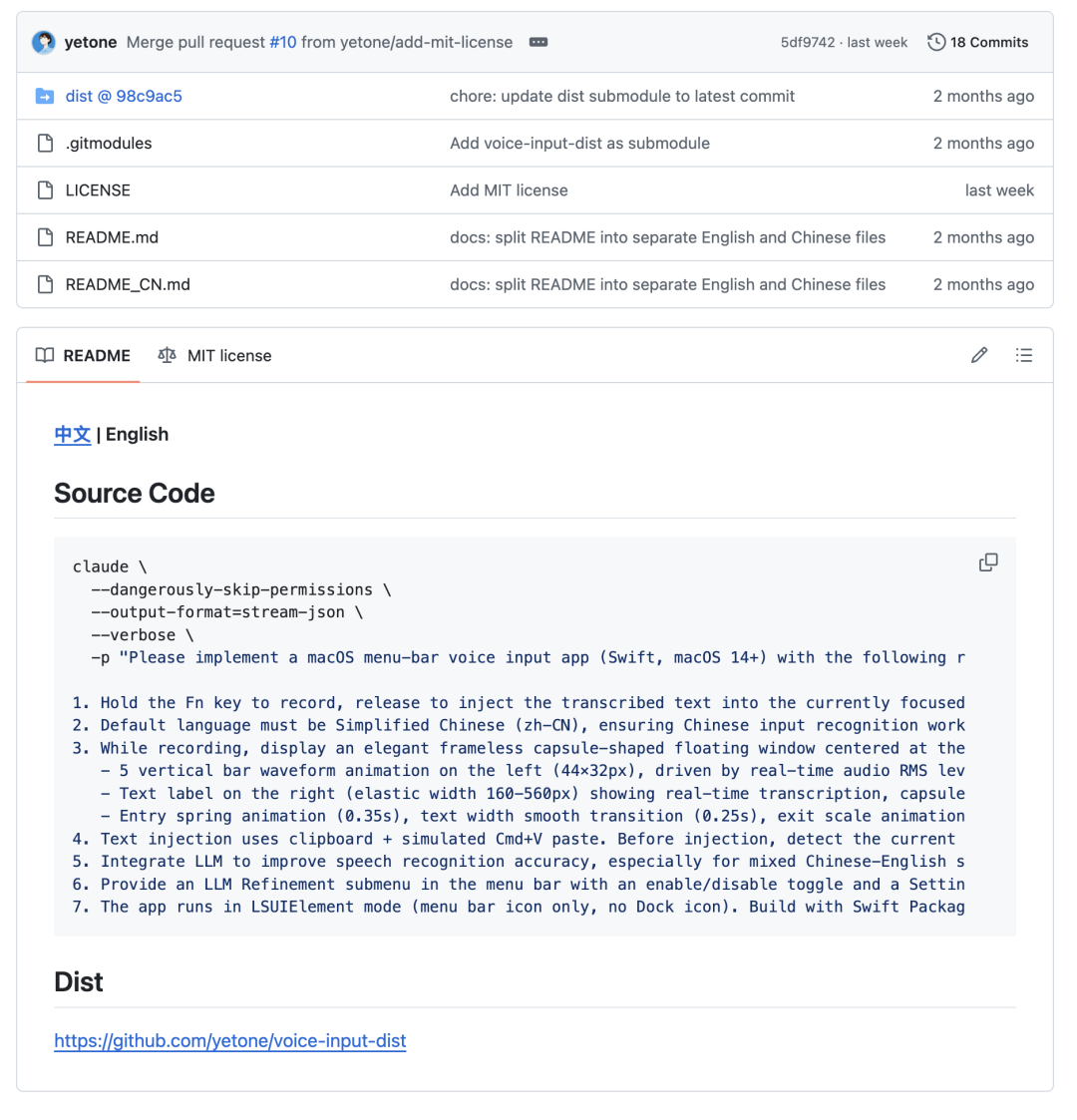
There isn't a single line of Swift code in the repo. The only content is README.md — which lays out a carefully crafted prompt describing how to build a macOS voice input app with SwiftUI + AVFoundation, and requiring features such as global Fn key listening, a semi-transparent NSPanel, and text polishing through an OpenAI-compatible API.
And then a lot of people really did reproduce it successfully.
I tried it myself and confirmed the same thing: I put the prompt into OpenCode (Plan mode + DeepSeek V4 Pro), it generated 12 tasks, and about an hour later a runnable app came out. I then spent a dozen minutes fixing one bug — the result was astonishing.
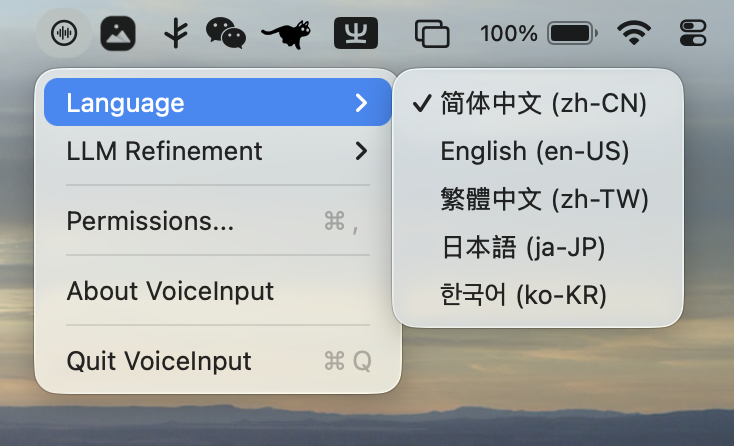
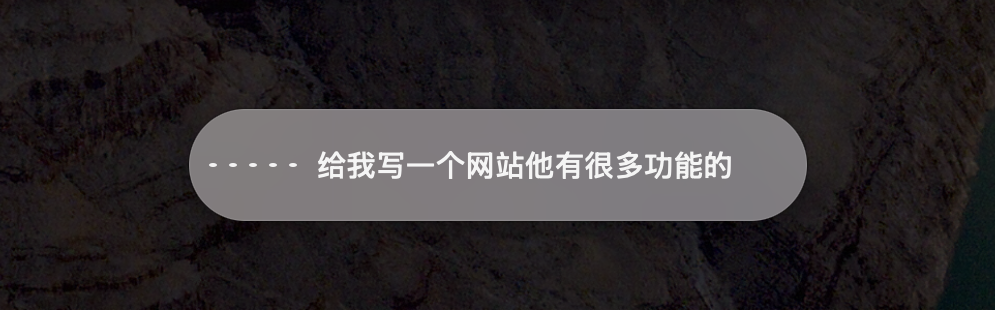
Here are screenshots of the app I built:
So, does this count as "open source"?
The AI's answer is: Yes!
It has the three core characteristics of traditional open source:
- Reproducibility Someone in the community reproduced it with CodeX + GPT, and I reproduced it with OpenCode + DeepSeek just the same.
- Collaboration By modifying the prompt, you can generate different variants. I've already seen another project port it to Windows.
- Distribution efficiency Write once, generate everywhere.
Of course, the differences from traditional open source are obvious too. Traditional open source relies on source code, reproduction is fully deterministic, and it depends on compilers and libraries; prompt-based open source relies on the prompt plus an AI model, and the reproduction result is affected by the specific model's capability and the temperature setting.
As developers, what we need to see is that behind this successful open-source prompt lie the author's macOS development skills and his understanding of the product. Or, looking at it more deeply, what the author is really open-sourcing is his approach to solving the problem — the structure and the boundary conditions.
Understanding of the product, deep research into the technology, and finally all of it distilled into a few hundred words of a prompt that can reliably generate a product.
This may be exactly the "open source" and capability model we need to re-understand in the AI era.