Google Opens Gemini to Hong Kong as the AI Knockout Enters Its Second Half
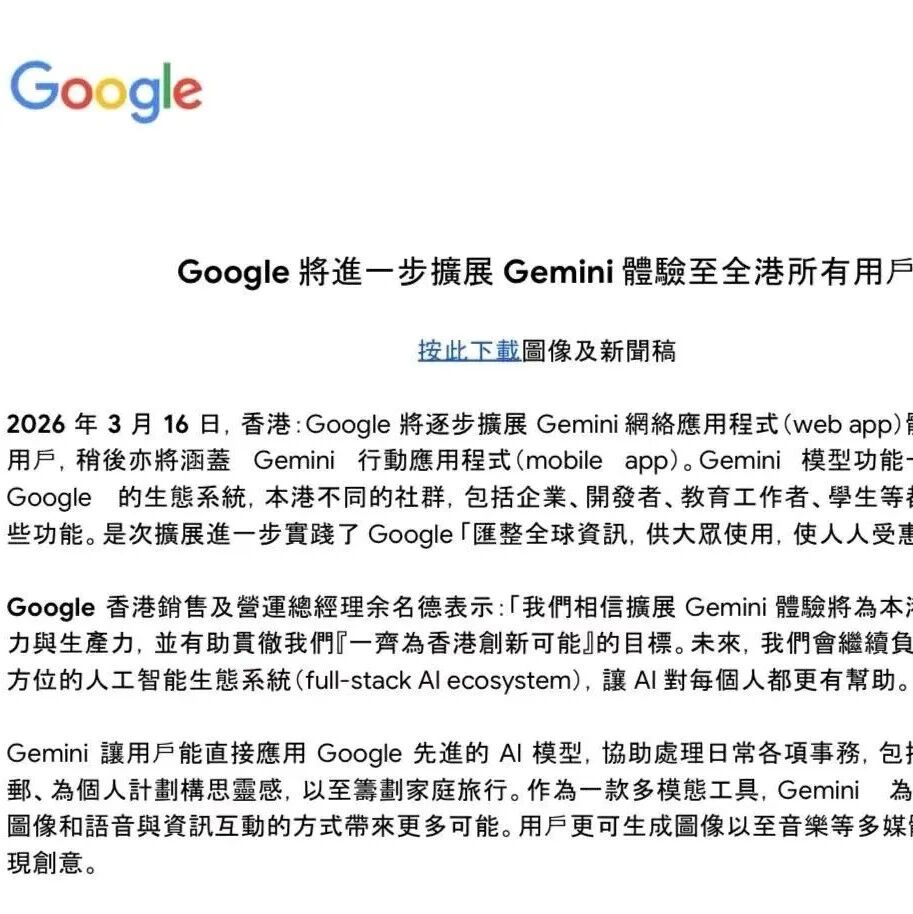
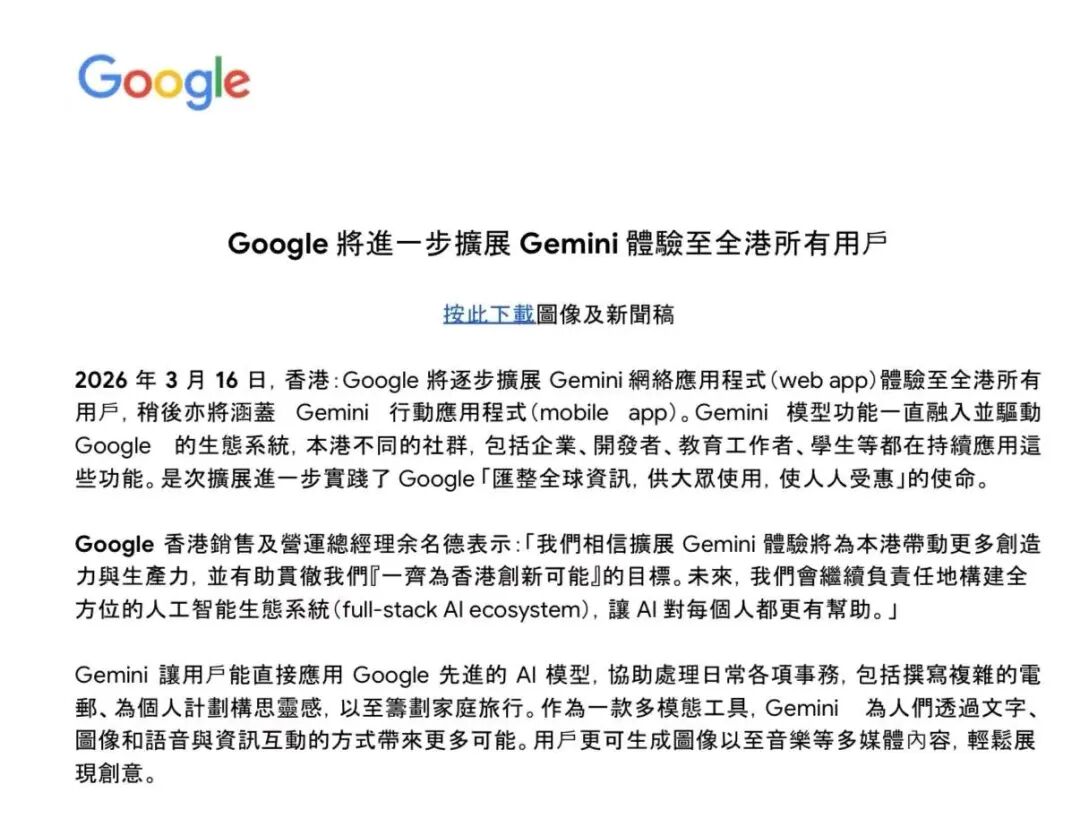
Chinese large models had just "attacked" their way overseas when Google "defended" right up to the doorstep. On March 16, 2026, Google announced it would gradually open the Gemini web app to Hong Kong users — no VPN needed, directly usable.
Chinese large models had just "attacked" their way overseas when Google "defended" right up to the doorstep.
1
On March 16, 2026, Google announced it would gradually open the Gemini web app to Hong Kong users — no VPN needed, usable directly.
The timing is delicate.
Just a week earlier, OpenRouter data showed that weekly call volume for Chinese AI models had beaten the US for two straight weeks. 4.69 trillion tokens vs. 3.29 trillion tokens — China ahead by 42%.
The first time on record.
Over the past week: MiniMax, DeepSeek, StepFun, Kimi — Chinese models took four of the global top ten by call volume, and swept the top three.
The Chinese market isn't fully open yet, but Chinese AI has already torn a gap open in overseas markets first.
Then Google showed up.
2
Hong Kong is an interesting place.
It's part of China, but under a different system. Google pulled out of mainland China years ago over compliance issues, but Hong Kong has always been a "window" — it reaches Chinese-language users without having to face mainland regulation head-on.
Opening Hong Kong this time works on several levels for Google:
Level one: stop the bleeding.
Chinese models are furiously devouring market share overseas. MiniMax's input price is 1/17 of Claude Opus 4.6's, and its output price is 1/23. Sixteen to twenty-three times cheaper. You're a developer — which one do you pick?
Google's calculation is simple: Hong Kong has 7 million people, so rope in this batch of users first and at least hold the base in the Asia-Pacific market.
Level two: testing.
If it works in Hong Kong, could the next step be copying it into other Chinese-speaking regions? Or even...?
Level three: defend and counterattack.
Chinese AI fought its way out with "low prices plus open source." Google can't rely on technical leadership alone; it has to trade market for time.
3
But I don't think this is just commercial competition.
Behind it is a collision of two approaches —
The Chinese route: application-driven.
Chinese AI companies don't take on the US over foundation-model parameters; they build up call volume first. MiniMax does social apps (Xingye/Talkie), Kimi does Agent, Zhipu does B2B — rope in the users first, then talk about technical depth.
After OpenClaw blew up, Chinese models became the "default backend" for developers worldwide. Once call volume goes up, a cost advantage turns into an ecosystem advantage.
The American route: technology-driven.
OpenAI raised $110 billion, and Anthropic was listed by the Pentagon as a supply-chain risk — Americans understand perfectly well that AI is the next generation of infrastructure and has to be held in their own hands.
Technical leadership is their moat.
4
My view: there are no winners in this competition, only leaders for a given stretch.
China wins on fast application, low cost, and a sharp nose for the market. But on the underlying capability of foundation models, the US is still stronger.
The US wins on technical depth and capital. But the closed nature of the Chinese market has instead forced out more pragmatic business models.
Opening Gemini in Hong Kong is, at heart, American companies realizing that they can no longer ignore the Chinese market.
It used to be China wanting out and not being able to get out. Now it's Americans wanting in, only to find:
This world is no longer the world it used to be.